Showing posts with label Penguin. Show all posts
// // Leave a Comment

Magellanic Penguin


Magellanic penguin is a small to medium sized species of penguin found inhabiting the rocky islands off the coast of parts of South America. The Magellanic is most closely related to the African penguin, the Galapagos penguin and the Humboldt penguin which it is similar in appearance to. Despite being classed as a threatened species, the Magellanic is one of the most numerous of all of these types of penguin. The penguin is found breed off the coast of Argentina and southern Chile and on the Falkland islands further south.


The Magellanic penguin is a medium sized penguin that can grow up to 76cm in height. Like other penguin species, the flippers of the this penguin are not that long but act as the perfect tools for propelling the this penguin through the water when it is in search of food. Like the other penguins in their group, Magellanic penguins have white and brownish black markings, with a broad dark band running across the top of their white chest. Like other penguin species, this is a highly sociable bird, living in flocks with numerous other Magellanic penguin individuals.


The Magellanic penguin primarily hunts cuttlefish and squid in the surrounding waters along with numerous species of fish (including sardines), and krill. Like other penguin species, the Magellanic penguin can dive quite deep for a few minutes at time in order to catch their prey. The relatively small size of the Magellanic penguin means that it is preyed upon by a number of hungry marine carnivores. Leopard seals and large fur seals are the primary predators of the Magellanic pen along with sharks and killer whales. Due to the fact that they nest on quite inhospitable land though, the Magellanic penguin has no natural predators on their breeding beaches.


The female Magellanic penguin lays two eggs in a nest on the beach which are incubated by both parents for up to 40 days. Once hatched, the chicks are cared for by their parents until they are about a month old and are able to fend for themselves. Today, although quite numerous in some parts, the Magellanic penguin in considered to be a threatened species primarily due to changes in their natural habitats. Oil spills are thought to be the biggest threat to the Magellanic penguin and their native breeding sites across south-east Pacific. Source
Read More
// // Leave a Comment

Macaroni Penguin


The macaroni penguin is a large-sized species of penguin found in the Sub-Antarctic regions. the macaroni penguin is one of six species of crested penguins is so closely related to the royal penguin, that some people class the two as the same species. The macaroni penguin spends most of its time during the colder winter months fishing in the cold oceans where the macaroni penguin is more protected from the bitter conditions of the Antarctic winter on the land.


The macaroni penguin is the most numerous species of penguin on the planet as there approximately 18 million macaroni penguin individuals. The macaroni penguin population numbers are declined severely over the past few decades meaning that the macaroni penguin is today considered to be a vulnerable species. Macaroni penguins are one the biggest and heaviest species of penguin as adult macaroni penguins generally average about 70cm in height. The macaroni penguin also has a couple of very distinctive features including a long red-coloured beak and a crest of thin bright-yellow feathers on its head.


Like other penguin species, the macaroni penguin is a carnivorous animal as the only source of food is in the surrounding water. The macaroni penguin spends six months during the cold winter months hunting fish, squid, krill and crustaceans which the macaroni penguin catches in its long beak. The macaroni penguin only has a couple of natural predators in the freezing Antarctic Ocean as there are only a number of animal species that can survive there. Leopard seals, killer whales and the occasional passing shark are the only real predators of the macaroni penguin.


The macaroni penguin returns to the land during the warmer summer months in order to breed. Macaroni penguins gather in large colonies which can contain up to 100,000 individuals in order to lay their eggs. Female macaroni penguins generally lay two eggs a couple of days apart that hatch after about six weeks. Both the male and female macaroni penguin parents help to incubate the eggs and raise the chicks. Source
Read More
// // Leave a Comment

King Penguin


The king penguin is the second largest species of penguin in the world, with adult king penguins growing to nearly a metre in height. There are two recognised sub-species of the king penguin found throughout the sub-Antarctic, with more than 2 million breeding pairs thought to be dotted across the rocky islands (a number which appears to be increasing). The king penguin is found inhabiting the rocky islands in parts of the Antarctic Ocean, with the geographical location being one of the main differences between the two king penguin sub-species. King Penguins breed on the sub-Antarctic islands, at the northern reaches of Antarctica, as well as around the Falkland Islands, and other temperate islands of the region.


The king penguin is one of the most elegant of all penguin species as it's long and slender body helps the king penguin to glide through the water with great ease. The bright-yellow markings on the head and neck of the king penguin are characteristic of this penguin species. King penguins have adapted well to the extreme living conditions of the Antarctic and, to keep warm, the king penguin has four layers of feathering. King Penguins have 70 feathers per every square inch. The outer layer of feathers are oiled and waterproof, and the inner three layers are down feathers, which act as very effective insulation as the bitter cold.


The king penguin is a carnivorous animal, that like all other penguin species, survives on a diet that is only comprised of marine animals. Krill and small crustaceans make up the bulk of the king penguin's diet along with larger organisms including squid and various species of fish. Due to the fact that they inhabit quite uncompromising regions, king penguins have no natural land-based predators. However, larger marine animals that also inhabit the freezing waters of the Antarctic Ocean will prey on these water-based birds, with leopard seals, sharks, humans and killer whales being the main predators of the king penguin.


On average, the king penguin breeds once a year, forming pairs that usually remain faithful to one another. The female king penguin lays two eggs which are incubated by both parents for about two months, when only one of the eggs will usually hatch. The king penguin chicks are fed and kept warm by their parents and remain with them until the chicks are about a year old. Today, the king penguin populations in the sub-Antarctic Oceans appear to be thriving and better still increasing in numbers with more than two million breeding pairs of king penguins found around the freezing waters. Source
Read More
// // Leave a Comment

Humboldt Penguin


The Humboldt penguin is a medium-sized species of penguin that is found breeding on the coasts of South America. The Humboldt penguin is similar in appearance to and closely related to other more northern penguin species including the African penguin, the magellanic penguin and the Galapagos penguin. The Humboldt penguin is one of the most northern-dwelling penguin species as it is found natively breeding on the coastlines of Peru and Chile. The Humboldt penguin is named after the cold water current that it spends most of it's time swimming in, which is itself named after the explorer, Alexander von Humboldt.


Humboldt penguins are medium-sized penguins that can grow to heights of 70 cm or more. Also the Humboldt penguin is undoubtedly very similar in appearance a number of other penguin species, the Humboldt penguin can be easily identified by the pink, fleshy base at the end of their bills. All penguins are fantastic swimmers and the Humboldt penguin is no exception. Humboldt penguins use their powerful flippers and streamlined bodies, aided by their webbed feet to soar through the water. Humboldt penguin populations have been severely affected in their native regions due to increasing commercial fishing which leaves less food for the penguins to eat.


The Humboldt penguin is a carnivorous animal, that like all other penguin species, survives on a diet that is only comprised of marine animals. Krill and small crustaceans make up the bulk of the Humboldt penguin's diet along with larger organisms including squid and various species of fish. Humboldt penguins can be at sea for days at a time whilst hunting and catch their food by diving deep into the water for minutes at a time. The Humboldt penguin has few predators on land, the main ones being large snakes and sea-birds that hunt their eggs.


Humboldt penguins nest on beaches and rocky islands along the South American coast, where their range in Chile overlaps that of the closely related magellanic penguin (these sites are known as rookeries). The female Humboldt penguin lays two eggs which are incubated for just over a month and usually fledge (leave the nest) when they are between 2 and 3 months old. Today, the Humboldt penguin populations throughout the Pacific Ocean have been drastically declining over the past few years, with human interference (mainly habitat loss and over-fishing) being the main cause. Source
Read More
// // Leave a Comment

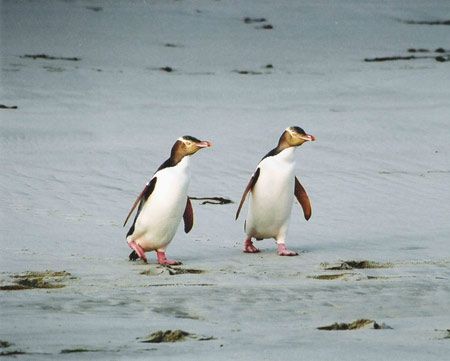
Yellow-Eyed Penguin


The yellow-eyed penguin is one of the few penguin species found north of the Antarctic Ocean, and as it's name suggests, this species of penguin is easily idenitfied by it's yellow coloured eyes and bright yellow band that runs from it's eyes round the back of the yellow-eyed penguin's head. The yellow-eyed penguin is found off the coast of the south island of New Zealand where this species gathers in colonies along the beaches and boulder fields. The yellow-eyed penguin is also found on a few of the islands of the main island including Stewart, Auckland and the Campbell Islands.


The yellow-eyed penguin generally searches for food up 10 miles offshore, and travels (on average) around 15 miles away from the colonies nesting site. The yellow-eyed penguin leaves the colony at dawn and returns the same evening during chick rearing, although may spend 2 or 3 days at sea at other times. The yellow-eyed penguin is one of the larger species of penguin with adult individuals reaching 75cm in height, with the males generally being slightly larger than the female yellow-eyed penguins.


The yellow-eyed penguin is a carnivorous animal, that like all other penguin species, survives on a diet that is only comprised of marine animals. Krill and small crustaceans make up the bulk of the yellow-eyed penguin's diet along with larger organisms including squid and various species of fish. The yellow-eyed penguin is usually found nesting in the forests and scrub that line the New Zealand coast and although historically undisturbed, the yellow-eyed penguin now has a number of land-dwelling predators including cats, dogs and foxes along with rats and weasels that hunt their eggs.


On average, the yellow-eyed penguin breeds once a year, forming pairs that usually remain faithful to one another. The female yellow-eyed penguin lays two eggs in her nest in the forest which are incubated by both parents for up to a couple of months, when only one of the eggs will usually hatch. The yellow-eyed penguin chicks are fed and kept warm by their parents and remain with them until the chicks are nearly a year old. Today, the yellow-eyed penguin listed as an endangered animal with an estimated wild population of less than 4,000 individuals. Source
Read More

Contact Form

Name

Email *

Message *