Showing posts with label Least Concern. Show all posts
// // 9 comments

The Moose Animal Biography

The Moose Animal

Biography of the Moose

The Moose also known as elk. These are found in the cold plains of North America and Europe where they were named by locals as twig-eaters. The male have enormous antlers that the moose actually renews once a year. After the warmer mating season the male will shed its antlers to conserve energy for the winter. In the springtime this animal begins to develop its new antlers which take from 3 to 5 months to fully grow.


The moose have been hunted by humans for both trophies but also for meat. They are also prey to a number of large carnivorous mammals which they encounter such as bears, cougars and arctic wolves. There are thought to be six different subspecies of animal found in the sub-arctic forests today. These are the European moose (found in Finland, Sweden and Norway), the Eastern moose (found in the east of Canada and northeast of the United States), the Western moose (found in the west of Canada), the Siberian moose (found in the east of Siberia and Mongolia), the Alaska moose (found in Alaska and Yukon) and the Shiras moose (found in Wyoming and Utah).


Life Cycle of Moose

Female moose do not have antlers and tend to give birth to the baby after an 8 month gestation period. The female tends to have a single calf but twins and triplets have been known. The fur of the baby is a reddish colour that turns to brown as these get older. The young calves tend to stay with the mother until just before the next young are born.


Although moose are not usually aggressive animals, particularly towards humans, when provoked, They have been known to attack humans. Although the consequences of their attack are generally minor, Animal have been known to attack more humans than bears and wolves put together. They live in herds and live until they are about 16 years old. Moose are herbivorous animals and spend their time foraging for vegetation and branches to munch on.
Read More
// // Leave a Comment

Kudu


The kudu is a sub-species of antelope that is found inhabiting mixed shrub woodland, and savanna plains in eastern and southern Africa. The kudu relies heavily on close, dense thickets in which the kudu can escape to and hide when it feels threatened. There are two species of kudu in Africa which are the Lesser kudu and the Greater kudu. Both kudu species are closely related and look very similar in appearance but there are a few distinctive ways that the lesser kudu and the greater kudu can be distinguished from one another.


Kudus are herbivorous animals and therefore have a completely vegetarian diet. Kudus forage in woodland and around thickets of shrubs nibbling on leaves from the trees and bushes. Kudus also eat other varieties of plant life such as herbs, flowers, berries and fallen fruits. Kudus are prey to a number of predators such as lions, leopards, cheetahs, wild dogs and the occasional large python that will hunt the smaller and more vulnerable kudu young. Kudu are able to run very fast but often have a hard time outrunning predators so the kudu rely on their agile ability to leap into forest and woodland where large carnivorous predators find it harder to chase them. The kudu will then often hide in woodland until the predator have eventually given up and left.


Kudus live in small herds of up to 24 kudu individuals. The kudu herds mainly consist of female kudus and their calves as male kudus tend to solitary and only come together with other kudus when it is time to mate. It has been known that groups of up to 8 male kudus will form a herd but this is very rare. The kudu mating season occurs at the end of the rainy season. The kudu gestation period is around 8 months after which time the female kudu will normally give birth to just one baby kudu. The baby kudus tend to be born around February and March when the grass is at it's highest and there is plenty of food to help the baby kudu calves to grow.


Kudus have both benefited and suffered from contact with humans. Humans find the kudu and easy target for hunting due to the fact that kudus tend to stop and look around after they have run away. Some local tribes people believe the kudu to be a sacred animal and therefore protect the kudu rather than killing it. Human settlements have also meant that the kudu habitat as changed and the kudu have had to move to other areas. This has actually done the kudu population the world of good as the kudu have been pushed into areas where there is a better source of water and therefore food. Source
Read More
// // Leave a Comment

King Penguin


The king penguin is the second largest species of penguin in the world, with adult king penguins growing to nearly a metre in height. There are two recognised sub-species of the king penguin found throughout the sub-Antarctic, with more than 2 million breeding pairs thought to be dotted across the rocky islands (a number which appears to be increasing). The king penguin is found inhabiting the rocky islands in parts of the Antarctic Ocean, with the geographical location being one of the main differences between the two king penguin sub-species. King Penguins breed on the sub-Antarctic islands, at the northern reaches of Antarctica, as well as around the Falkland Islands, and other temperate islands of the region.


The king penguin is one of the most elegant of all penguin species as it's long and slender body helps the king penguin to glide through the water with great ease. The bright-yellow markings on the head and neck of the king penguin are characteristic of this penguin species. King penguins have adapted well to the extreme living conditions of the Antarctic and, to keep warm, the king penguin has four layers of feathering. King Penguins have 70 feathers per every square inch. The outer layer of feathers are oiled and waterproof, and the inner three layers are down feathers, which act as very effective insulation as the bitter cold.


The king penguin is a carnivorous animal, that like all other penguin species, survives on a diet that is only comprised of marine animals. Krill and small crustaceans make up the bulk of the king penguin's diet along with larger organisms including squid and various species of fish. Due to the fact that they inhabit quite uncompromising regions, king penguins have no natural land-based predators. However, larger marine animals that also inhabit the freezing waters of the Antarctic Ocean will prey on these water-based birds, with leopard seals, sharks, humans and killer whales being the main predators of the king penguin.


On average, the king penguin breeds once a year, forming pairs that usually remain faithful to one another. The female king penguin lays two eggs which are incubated by both parents for about two months, when only one of the eggs will usually hatch. The king penguin chicks are fed and kept warm by their parents and remain with them until the chicks are about a year old. Today, the king penguin populations in the sub-Antarctic Oceans appear to be thriving and better still increasing in numbers with more than two million breeding pairs of king penguins found around the freezing waters. Source
Read More
// // Leave a Comment

Howler Monkey


Howler monkeys (genus Alouatta monotypic in subfamily Alouattinae) are among the largest of the New World monkeys. Fifteen species are currently recognised. Previously classified in the family Cebidae, they are now placed in the family Atelidae. These monkeys are native to South and Central American forests. Threats to howler monkeys include human predation, habitat destruction and being captured for captivity as pets or zoo animals.


These monkeys are famous for their loud howls, which can travel three miles through dense forest. Howler monkeys have short snouts and wide-set, round nostrils. Their noses are very keen, and the Howler monkey can smell out its food (primarily fruit and nuts) up to 2km away. Their noses are usually roundish snout-type, and the nostrils have many sensory hairs growing from the interior.


They range in size from 56 to 92 cm (22 to 36 in), excluding their tails, which can be equally as long, in fact in some cases the tail has been found to be almost 5 times the body length. This is a prime characteristic. Like many New World monkeys, they have prehensile tails, which they use for picking fruit and nuts from trees. Unlike other New World monkeys, both male and female howler monkeys have trichromatic color vision.

Howler monkey Credit

This has evolved independently from other New World monkeys due to gene duplication. They have lifespans of 15 to 20 years. Howler species are dimorphic and can also be dichromatic (i.e. Alouatta caraya). Males are, on average, 1.5 to 2.0 kg heavier than females. The hyoid of Alouatta is pneumatized, one of the few cases of postcranial pneumaticity outside Saurischia. Howler monkeys generally move quadrupedally on the tops of branches, usually grasping a branch with at least two hands or one hand and the tail at all times.
Read More
// // Leave a Comment

Horseshoe Crab


The horseshoe crab is a hard-shelled invertebrate found on the sea floor in warmer climates. Despite it's name, the horseshoe crab is not actually a crab (or crustacean) and is in fact more closely related to arachnids such as spiders and scorpions. There are four different species of horseshoe crab found inhabiting the warmer shallows off the coasts of India, Japan, Indonesia, the eastern USA, and the Gulf of Mexico.


The horseshoe crab has a hard outer shell, five pairs of legs and a long, thin tail which the horseshoe crab uses for changing direction whilst swimming rather than as a defensive weapon. The appearance of the horseshoe crab is thought to have changed very little from when it first evolved around 500 million years ago. Horseshoe crabs breathe using book gills, which are thin plates found on the abdomen of the horseshoe crab.


Horseshoe crabs are generally nocturnal animals, coming out of the shadows in the darkness in order to hunt for food. As carnivorous animals, horseshoe crabs only eat meat including sea worms, small molluscs and crustaceans. Thanks to their armoured casing, horseshoe crabs have few natural predators and are primarily hunted by sharks and sea turtles. Humans also widely hunt the horseshoe crab around the world, along with coastal birds that pick the horseshoe crabs out of the shallows.


Female horseshoe crabs are known to lay between 60,000 to 120,000 eggs at a time. After mating, the female horseshoe crab lays her eggs into a hole in the sand which she then covers up to protect them. Today, the horseshoe crab is still found widely along the world's warmer coastlines although horseshoe crab populations in certain areas are suffering from high levels of water pollution and over-fishing. Source
Read More
// // 1 comment

Jellyfish


Jellyfish (also known as jellies and sea jellies) are boneless animals that float freely through the world's oceans. Although jellyfish exist in our oceans worldwide they are particularly prominent in coastal areas. Jellyfish can be found in all shapes and sizes from just a few inches in diameter to well over a metre. There are thought to be around 2,000 different species of jellyfish, the most common being the big, colourful ones found in warmer coastal areas. There are four different types of jellyfish that are categorised by their shape and the way in which they behave.


Despite the name, jellyfish are not actually fish but are instead classed in a group of their own as they are unlike any other animal on Earth. The body of the jellyfish is made up of a non-living jellylike substance called mesoglea. This jelly is surrounded by a layer of skin that is just one cell thick. The body of the jellyfish is mainly made up of water, around 90% in fact. Jellyfish also have tentacles around their mouths that vary in length depending on the species of jellyfish. The jellyfish use their tentacles to both catch and sting their prey.


Some jellyfish stings contain poison which the jellyfish uses to stun and kill its prey. The box jellyfish, found in the oceans around Australia, has a sting powerful enough to be fatal to humans. The long tentacles of the jellyfish are what produces the sting. Its been tried and tested...you can touch the top of the jellyfish without being hurt! The jellyfish is a carnivorous animal and despite it's appearance, the jellyfish is a remarkably efficient predator. Jellyfish use their tentacles to stun their prey before grabbing onto it and bringing it into their mouth.


Due to the fact that many species of jellyfish are transparent, they are often hard for predators to spot. However, jellyfish are drifters and move very slowly through the water sometimes using their tentacles to propel them along. Jellyfish are eaten by humans, sharks, squid and occasionally birds. Jellyfish release their eggs and sperm into the water which eventually meet and the egg is fertilised. The jellyfish egg quickly becomes and embryo and begins to develop in it's water world. Source
Read More
// // Leave a Comment

Jackal


The jackal is a medium sized member of the dog family, originally found in Africa, Asia and southeast Europe. There are four main species of jackal with these jackal species being the golden jackal, the side-striped jackal, the black-backed jackal and the Ethiopian wolf jackal. The golden jackal is the most northernly species of jackal and can be found as far east as Burma in Southeast Asia. Jackals are generally found in packs of roughly between 10 and 30 jackal individuals.


Jackals are small canines that have adapted to hunting small mammals, birds and reptiles. Some species of jackal have even been known to eat poisonous snakes. Jackals are carnivorous mammals and jackals will often scavenge the remains of kills made by other larger predators. The jackal is a nocturnal mammal that can easily maintain speeds of 16km an hour for long periods of time. Although the jackal belongs to a jackal pack, jackals often prefer to hunt alone or with only one other jackal.


Although the majority of the diet of the jackal is made up of meat, many jackal individuals (particularly those jackals living in the tropics of Southeast Asia) will often eat plant matter if no meat can be found. Jackals are very territorial animals and jackals have no hesitation in defending their marked territory. Jackals have a wide range of vocal sounds that are specific to each jackal family meaning that is rare for families of competing jackals to come into accidental contact with one another.


Jackals inhabit crevices in rocks and dens made by other animals in order to keep the jackals cool while they sleep. Although many jackal individuals live a nocturnal existence, particularly those jackals that inhabit areas close to humans, some jackals in more remote areas are slightly more diurnal and will be out hunting during the cooler times of the day. Source
Read More
// // Leave a Comment

Impala


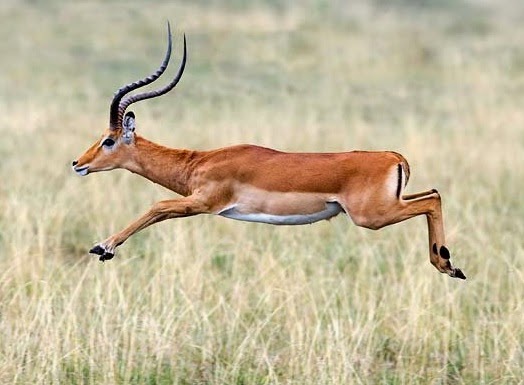
The impala is one of the many species of antelope that is found inhabiting the African wilderness. The impala is a medium-sized antelope that is primarily found in the savannas and thicker bush-land in the more southern parts of the African continent. The male impala are well-known for their curved horns that are able to reach lengths of around 90 cm hats bigger than the average impala individual.
 
Impala Credit
 
The male impala are known as rams, mainly due to the fact that the male impala use their horns when defending themselves both from other dominant male impala and from oncoming predators. The female impala do not have horns at all and they are known as ewes. The impala is thought to be one of the most adaptable animals living in the African savanna, as the impala is able to change its eating habits with the seasons and depending on what is available in the near surroundings.
 

Impala like to graze on fresh grass but will also nibble on shoots and foliage when there is no grass growing nearby. The impala has many natural predators in the tough African landscape that include leopards, lions, cheetahs, crocodiles and hyenas. The impala though has a remarkable response when it feels threatened as the impala is able to jump over nine meters in distance and over two meters high.
 

The impala is thought to do this in order to confuse its predators. The average impala individual, lives for around 12 years in the wild although this varies a great deal as the impala is such substantial prey to many of the carnivorous African predators. Some impala individuals that have been bred in captivity have been known to get to more than 20 years old. Source
Read More
// // Leave a Comment

Zebu


The zebu is a species of cattle that is native to the jungles of South Asia and the Zebu is the only cattle species that can easily adapt to life in the hot tropics. The zebu is also known as the humped cattle as the zebu has a very distinctive hump on its upper back, located behind the head and neck of the zebu. Today the zebu can also be found in Africa, as the zebu was transported there from Asia many years ago. There are thought to be around 75 different species of zebu, with roughly half the zebu species found in Africa and the other half of the zebu species found in South Asia.


The zebu is one of the smallest species of cattle in the world with adult zebus reaching a height of just over a meter. The zebu is also about half the weight of a typical cow as the zebu is considered to have less meat. The small size of the zebu is thought to be the reason why the zebu is able to thrive in tropical climates, where other species of cattle do not fair so well. The zebu is a distinctive breed of cattle and besides the hump found on the shoulders of the zebu, the zebu also has a large flap of skin below its lower jaw, known as a dewlap, and the zebu also has long drooping ears.


The hump-less cattle found throughout Africa today are considered to be a subspecies of the zebu that have adapted to life without their characteristic hump. Nevertheless, these hump free cattle are able to survive without complaint in their subtropical environment. Due to the manageable size of the zebu, and the ability of the zebu to cope with the tropicals climates, the zebu has been domesticated in both its Native home in Southern Asia and in Africa as the zebu is predominantly used for lighter agricultural work.


The zebu is thought to have both parasite and disease resistant properties which is another reason why the zebu are thought to thrive so successfully in their native tropical environments. The zebu has also been interbred with the native cattle of both Africa and Brazil, where the zebu is most common outside of Asia, and many farmers consider the presence of a hump and droopy ears to be a sign that their cattle is purely bred. There are thought to be nearly 4 million zebu in farms around the world today, with the highest number of these being found in India, Brazil and the United States. Source
Read More
// // Leave a Comment

Woodpecker


There are around 200 species of woodpecker inhabiting the forests and woodlands worldwide. Woodpeckers are found on every continent with the exception of the polar regions, Australia and Madagascar. The smallest species of woodpecker is the Bar-breasted Piculet that only grows to 8cm in height. The Gray Slaty woodpecker from south east Asia is the largest living woodpecker in the world with some of these woodpecker individuals growing to nearly 60 cm tall.


The woodpecker has a distinctive long beak, which the woodpecker uses to make holes in trees. The woodpecker does this in order to dig out the grubs living under the bark. The average woodpecker is able to peck up to 20 pecks per second! The woodpecker is only able to peck so much and move it's head so quickly without getting a headache due to the air pockets that help to cushion the woodpecker's brain. Woodpeckers are omnivorous birds and feed on a mixture of plants and animals (mainly insects). The woodpecker eats seeds, berries, fruits, nuts and bugs but the exact species of the woodpecker's food depends upon the area which the woodpecker inhabits.


Most species of woodpecker inhabit forest and woodland areas although oddly enough, there are a few species of woodpecker that live in areas such as deserts and on hillsides, where there are no trees at all. These few woodpecker species still behave in a similar way and nest in holes in rocks and in plants such as cacti. Many of the 200 species of woodpecker on Earth, are today considered to be threatened or endangered animals. This is mainly due to the deforestation that is occurring on mass across the world, meaning that woodpeckers are losing their homes.


Woodpeckers often have quite brightly coloured feathers although the exact colours of the woodpecker's feather depend on the woodpecker species. The brightly coloured feathers of the woodpecker which are often greens, browns, whites, reds and greys, help the woodpecker to camouflage more effectively into the surrounding forest. Woodpeckers make their nests in trees and excavate the hole themselves. Woodpeckers do not usually line the nest as the wood chippings that are there from when the woodpecker made the hole, act as a soft lining. The female woodpecker lays between 3 and 5 eggs that hatch after an incubation period of just a couple of weeks.  Source
Read More
// // Leave a Comment

White Face Capuchin


The white faced capuchin also known as the white headed capuchin and the white throated capuchin, is a medium sized species of monkey that is native to the jungles of Central America and the northern regions of South America. The white faced capuchin is one of the most well known monkeys, particularly in North America, and the white faced capuchin is thought to be one of the most intelligent monkeys in the world with the white faced capuchin being best known as a companion for organ grinders and are also used to assist people that are paraplegic.


The white faced capuchin plays a vital role in the eco-system where the white faced capuchin inhabits, as the white faced capuchin is one of the most effective dispersers of plant and fruit seeds throughout the jungle. The white faced capuchin does this by eating the fruits and berries that grow in the surrounding jungle and the seeds are then put back into the ground in the feces of the white faced capuchin. The white faced capuchin live in troops which generally contain around 20 individual white faced capuchin members.

The white faced capuchin is a highly adaptable mammal and is known to live in all different types of forest in Central and South America. Although the white faced capuchin mainly feeds on fruits and berries, the white faced capuchin also eats insects, plants and even small creatures such as frogs and birds. Within a white faced capuchin troop, there tend to be more female white faced capuchin members than males and as with many other species of sociable primates.


The white faced capuchin troop generally has an alpha male member whose primary role is to breed with the female members and to protect their troop. White faced capuchin troops are not thought to be highly territorial as they spend a great deal of their time on the move. On average a white faced capuchin will travel 2 km every day but there always seems to be conflict when faced with a different troop of white faced capuchin monkeys. Source
Read More
// // Leave a Comment

Vampire Bat


The vampire bat is a small species of bat, native to the tropics of Central and South America. There are three recognised sub-species of vampire bat, all of which are in a genus of their own despite their obvious similarities. The common vampire bat, the hairy-legged vampire bat and the white-winged vampire bat are all closely related and share the same unique feeding habits, as they are the only known mammals that feed entirely on blood. Over time, vampire bats have perfectly adapted to the consumption of their only food source, with a leaf-like heat sensor on the end of their nose which detects where the warm blood is flowing closest to the skin.


The vampire bat is quite a small animal, with it's body rarely growing larger than the size of a human thumb. It's wings are long, finger-like bones that are covered in a thin layer of skin, with a thumb claw that pokes out of the front and is used for grip when clambering about on their host. Vampire bats have dark brown to grey furry bodies with a lighter underside, and strong limbs which enable them to crawl about on the ground with ease. As with other bats, vampire bats use echolocation in order to determine their surroundings.


When flying, they produce high-pitched sounds that bounce of the objects in the area, and it is this bounced-back sound that allows the bat to figure out where things are around them (it is so high-pitched that it cannot be heard by people). Vampire bats use echolocation, sound and smell in order to find their prey, which can be up to 10,000 times the size of this tiny predator, and it is because of this that vampire bats have evolved to taking some precautions when feeding.


Despite being a unique and versatile predator itself, the vampire bat is still prey to other animals, that can hunt the bat in the air when it comes out to hunt at night. Large, sharp-eyed birds of prey such as hawks and eagles are the most common predators of the vampire bat, along with snakes that hunt the bats in their dark caverns while they are sleeping during the day. Humans though are one of their biggest threats, mainly farmers that are known to poison the bats that commonly feed on their livestock. Source
Read More
// // Leave a Comment

Wrasse


The wrasse is a typically small species of fish, found in the coastal waters of the world's major oceans. The Cleaner wrasse is the most commonly known wrasse species as it is often seen alongside other marine animals, including sharks. There are more than 500 different species of Wrasse found in the shallower coastal waters and coral reefs, of the Pacific, Indian and Atlantic oceans. Wrasse most commonly inhabit areas that have an abundance of both food and places to hide, making coral reefs and rocky shores the perfect home for the wrasse.


Cleaner wrasse are the most well-known wrasse species as they are often seen going into the mouths of large marine animals in order remove the dead material inside. Cleaner wrasse feed on dead tissues, scales and parasites that lurk inside the mouth of the larger animal, and few are actually eaten by the predator that they are assisting. Wrasse come in a variety of colours and sizes depending on the species of wrasse. Wrasse tend to be relatively small in size, with many species of wrasse being less than 20 cm in length. One species of wrasse however is enormous in comparison, growing to more than 2 meters long.


Wrasse are carnivorous animals that have thick lips with a row of teeth that usually face outwards. The mouth of the wrasse is protractile which means that it is capable of extending forwards. Wrasse feeds on a number of small invertebrates, small fish and food particles in the water. Wrasse are also known to follow large predatory fish, eating the trail of left-overs that it leaves behind it. Due to their small size, wrasse have numerous predators in their natural environment including larger fish, such as lionfish, dogfish and barracuda and wrasse are even eaten by some smaller species of shark.


Wrasse are known to live for a relatively long-time particularly for their small size. Wrasse mate by releasing their eggs and sperm in to the water, which are fertilised and become part of the plankton until they are big enough to join the reef. Female wrasse lay thousands of eggs at at time so the wrasse population numbers are relatively high. Source
Read More

Contact Form

Name

Email *

Message *