Showing posts with label A. Show all posts
// // Leave a Comment

Asian Tapir

 
The Malayan Tapir, also called the Asian Tapir, is the largest of the four species of tapir and the only one native to Asia. The Malayan Tapir is the largest of the tapir species and has a distinctive white band across it's body. The Malayan Tapir once roamed the tropical forests across South East Asia but the Malayan Tapir today has a much smaller range primarily due to habitat loss.


The Malayan Tapirs are primarily solitary creatures, marking out large tracts of land as their territory, though these areas usually overlap with those of other individuals. Tapirs mark out their territories by spraying urine on plants, and they often follow distinct paths which they have bulldozed through the undergrowth. The Malayan tapir eat grass and nuts, water plants, and fruits.


They put food in their mouths using their noses, just like an elephant. Exclusively a vegetarian, the animal forages for the tender shoots and leaves of more than 115 species of plants (around 30 are particularly preferred), moving slowly through the forest and pausing often to eat and note the scents left behind by other tapirs in the area. The Malayan Tapirs have black and white sections like the Giant Panda. You'd think it would make them stand out, but tigers and other predators have a hard time finding them.
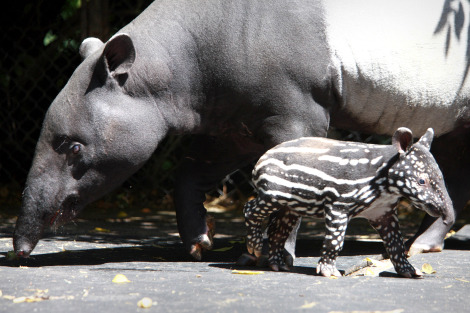

Malayan Tapirs go out at night, so predators can only see the white parts of them. Predators can't see their shape. They look relaxed, but can run away very quickly if in trouble. If they see a predator, they quickly hide under water. The Malayan Tapirs are skilled swimmers that live in forests where there is water. The forests are disappearing. Living in small numbers in small forests, it's hard to find food. They're also have trouble on finding mates. Source
Read More
// // Leave a Comment

Amami Rabbit


The Amami Rabbit  or Amamino kuro usagi, also known as the Ryukyu Rabbit, is a primitive dark-furred rabbit which is only found in Amami Ōshima and Toku-no-Shima in Japan. The dark-furred Amami Rabbit is known as a living fossil. Its characteristics are identical to rabbits who lived five million years ago. With its small ears and dark eyes the Amami Rabbit (Pentalagus furnessi) contrasts greatly with its more familiar fluffy, white relatives, and yet it's the Amami's distinctive features that make this rabbit so important to the study of the animal world.


Baby Rabbits are called kits, kittens, or bunnies. Some sources say the Amami Rabbit only has one kit at a time, and other sources say they have two to three, but it is agreed that they generally have two litters each year. The mother builds a den lined with plant materials and tufts of fur then seals the top with the same material so it looks like the rest of the forest floor. Like other rabbits, the mother leaves her offspring to hunt and only returns every other night in an effort to keep predators from locating her den.


She can even feed the kit without completely uncovering the den. She unseals the den when the kit is between four and seven weeks old and the baby rabbit joins its mother on the evening hunt for food. The Amami Rabbit eats grass, fresh branches, and nuts. The Amami Rabbit raises its offspring in rabbit holes. Except at times when the mother feeds milk to her offspring, she will cover the rabbit hole with dirt to conceal it. Isn't that clever!


The reason why the Amami Rabbit retains its primitive form is because this form best suits them for life on the island. But as more people came to the island, the environment started to change. People continued to cut down trees, wiping out sources of food and refuge for the Amami Rabbit. Amami Rabbits are also frequently attacked by mongooses, which were originally brought to the island to exterminate the Habu, a venoemous snake. Today, the Amami Rabbit is on the brink of extinction. Source
Read More
// // Leave a Comment

African Wild Ass


The African Wild Ass is a wild member of the horse family, Equidae. This species is believed to be the ancestor of the domestic donkey which is usually placed within the same species. They live in the deserts and other arid areas of northeastern Africa, in Eritrea, Ethiopia and Somalia; it formerly had a wider range north and west into Sudan, Egypt and Libya. About 570 individuals exist in the wild. The African Wild Ass is suited for life in the desert, capable of going on for up to three days without drinking water.


African wild asses are well suited to life in a desert or semidesert environment. They have tough digestive systems, which can break down desert vegetation and extract moisture from food efficiently. They can also go without water for a fairly long time. Their large ears give them an excellent sense of hearing and help in cooling. Because of the sparse vegetation in their environment wild asses live somewhat separated from each other (except for mothers and young), unlike the tightly grouped herds of wild horses. They have very loud voices, which can be heard for over 3 km, which helps them to keep in contact with other asses over the wide spaces of the desert.

The African Wild asses can run swiftly, almost as fast as a horse. However, unlike most hoofed mammals, their tendency is to not flee right away from a potentially dangerous situation, but to investigate first before deciding what to do. When they need to, they can defend themselves with kicks from both their front and hind legs. The African Wild Ass eats plant material, often eating thorn bushes and tougher plants that other animals ignore. They need to have water at least every three days, but they are able to survive on water that is dirty and brackish and can get a lot of their moisture from the plant material that they eat.


Sexual maturity of the female ass usually happens by the time she reaches two. Males can also reproduce at two, but it is so competitive that they usually are forced to wait until they are around four. Males are very territorial and will often hold a huge territory that is about 23 km, and they mark the edges of their territories with dung. Other males are allowed in, but they are kept away from the females as much as possible. Male donkeys will bray when the females are in season, and a dominant male of a territory has first right to breed with any female that comes around. Source
Read More
// // Leave a Comment

Asian Wild Ass


The Asian Wild Ass was once considered to be among the largest population of ungulates, along with horses, cows, camels, and deer. Herds of 1,000 or more Asian Wild Asses have often been observed in Central and West Asia. Like many other large grazing animals, the asian wild ass' range has contracted greatly under the pressures of hunting and habitat loss, and of the six subspecies, one is extinct and two are endangered.


Asian Wild Ass are a little larger than donkeys at about 290 kilograms  and 2.1 metres , and are a little more horse-like. They are short-legged compared to horses, and their coloring varies depending on the season. They are generally reddish-brown in color during the summer, becoming yellowish-brown in the winter months. They have a black stripe bordered in white that extends down the middle of the back. They are notoriously untameable.


The Asian Wild Ass lives in the grasslands and deserts of Central and West Asia.Most people associate a donkey with a slow moving animal, but the Asian Wild Ass is one of the fastest running asses in the horse family. They can run 70 kilometers or more per hour in short spurts. The kiang , a Tibetan relative, was previously considered to be a subspecies of the asian wild ass as E. hemionus kiang, but recent molecular studies indicate that it is a distinct species.


Today, the Asian Wild Ass is on the brink of extinction. This is partially due to the expansion of grazing land. Livestock animals have taken over their grassland and watering areas. But it is also because of an expansion of farmlands which has shrunk their habitat and forced them to separate. No longer is it possible to see herds of 1,000 asses. Conservation efforts have helped them recover their population in some areas, but as a whole, the Asian Wild Ass is still an endangered species. Source
Read More

Contact Form

Name

Email *

Message *