Showing posts with label Endangered. Show all posts
// // 1 comment

Manatee


The manatee is a large marine mammal and it is also commonly known as the sea cow. It is found in warmer waters only in the eastern hemisphere around subtropical regions such as Florida and the Caribbean. The average species can often weight more than 500kg and can grow to lengths of over 4.5 meters. Despite their large size it is not uncommon for the it to reach more than 70 years old.


The manatee spends most of its time grazing on plants in warm, shallow waters that are seldom deeper than a couple of meters. It is a herbivore and therefore only really feeds on aquatic plants like sea grass and algae but it has been thought that certain species of it may eat smaller fish but not necessarily on purpose . The female generally grows to larger sizes than the male meaning that the female is also heavier than the male. The large size of the manatee makes the it one of the biggest mammals in the world, but the this animal obviously has a long way to go before it will be the size of a blue whale!


Manatees inhabit warm, shallow marshlands under water, where the these spends a great deal of its time sleeping. As the manatee is indeed a mammal, do not have gills and therefore cannot breathe underwater so it has to resurface regularly in order to take in air. These are usually breed only once every couple of years, with the manatee gestation period lasting about a year. These only give birth to one manatee calf at a time. Mother then spend 12 to 18 months to weaning the manatee calf.


Manatees can often be seen in large herds, often of more than 20 individuals. This however, is quite rare as it is generally a solitary animal and with the exception of the mother nursing her calf, it tend to spend most of their time alone. The manatee has been linked to mermaids in ancient folklore and the people of West Africa, believed this animal to be sacred so anyone that killed a manatee was a sinner. The people of South America, would hunt this animal for their meat and then use the bones of this animal to treat basic ailments.


Despite popular belief, the dugong is not another name for the manatee, or even a type of this animal. The dugong inhabits waters close to Australia and although closely related to this animal, the two have one obvious difference. The tail of the manatee is broad and flat, but the tail of the dugong is forked and therefore more fish-like in appearance. Source
Read More
// // Leave a Comment

Magellanic Penguin


Magellanic penguin is a small to medium sized species of penguin found inhabiting the rocky islands off the coast of parts of South America. The Magellanic is most closely related to the African penguin, the Galapagos penguin and the Humboldt penguin which it is similar in appearance to. Despite being classed as a threatened species, the Magellanic is one of the most numerous of all of these types of penguin. The penguin is found breed off the coast of Argentina and southern Chile and on the Falkland islands further south.


The Magellanic penguin is a medium sized penguin that can grow up to 76cm in height. Like other penguin species, the flippers of the this penguin are not that long but act as the perfect tools for propelling the this penguin through the water when it is in search of food. Like the other penguins in their group, Magellanic penguins have white and brownish black markings, with a broad dark band running across the top of their white chest. Like other penguin species, this is a highly sociable bird, living in flocks with numerous other Magellanic penguin individuals.


The Magellanic penguin primarily hunts cuttlefish and squid in the surrounding waters along with numerous species of fish (including sardines), and krill. Like other penguin species, the Magellanic penguin can dive quite deep for a few minutes at time in order to catch their prey. The relatively small size of the Magellanic penguin means that it is preyed upon by a number of hungry marine carnivores. Leopard seals and large fur seals are the primary predators of the Magellanic pen along with sharks and killer whales. Due to the fact that they nest on quite inhospitable land though, the Magellanic penguin has no natural predators on their breeding beaches.


The female Magellanic penguin lays two eggs in a nest on the beach which are incubated by both parents for up to 40 days. Once hatched, the chicks are cared for by their parents until they are about a month old and are able to fend for themselves. Today, although quite numerous in some parts, the Magellanic penguin in considered to be a threatened species primarily due to changes in their natural habitats. Oil spills are thought to be the biggest threat to the Magellanic penguin and their native breeding sites across south-east Pacific. Source
Read More
// // 2 comments

Macaw

Scarlet Macaw Credit

The macaw is a colourful tropical parrot native to Central and Southern America. There are 17 different species of macaw found in the rainforests of South America. Many of the different macaw species are today considered to be endangered animals. The macaw is an omnivorous animal and feeds on nuts and fruit in the trees along with insects, eggs and small mammals and reptiles. The macaw is known to sleep during the night meaning that the macaw is a diurnal animal, and in the morning the macaw will often fly long distances in order to find food.

Blue Macaw Credit

The macaw is one of the largest species of parrot in the world, with the average adult macaw growing to more than a meter in height. The macaw is well known for it's array of brightly coloured feathers which are often many different colours including blue, red, yellow and green. Macaws have recently become very popular as pets, and there is a flourishing black market for some of the rarer breeds of macaw. This only contributes to their endangered status. Please, do not buy imported macaws.


The macaw has a large and powerful beak which means that the macaw can break the shells of nuts and seeds more easily. Like other species of parrot, macaws have four toes on each foot, with two toes facing forward and two toes facing backward. This foot adaptation helps the macaw to grip onto prey and tree branches more easily and allows the macaw to perch in the trees without slipping off. Macaws are known to be intelligent and very sociable birds and macaws can often be seen together in large flocks of up to 30 macaw individuals.


The macaw is one of the world's animals that is known to have the same breeding partner for their whole lives. Macaw couples do not only breed together but they also share their food and help to groom one another. When the female macaw has laid her eggs (typically 2 but more are common), the female macaw sits on her eggs to incubate them while the male macaw hunts and collects food for them both. The macaw chicks hatch after about a month. Source
Read More
// // Leave a Comment

Malayan Tiger


The Malayan tiger is a smaller-sized subspecies of tiger, found throughout Malaysia and parts of Thailand. The Malayan tiger is today an endangered species but one of the more numerous wild tiger species. The Malayan tiger is found throughout the southern and central parts of the Malay Peninsula with its range also extending into parts of southern Thailand. The Malayan tiger is found inhabiting the less-dense forests and jungles where there is a higher supply of food.


The Malayan tiger is the smallest species of tiger along with the Sumatran tiger, with average female Malayan tigers growing to around 2 meters in length. The smaller size of the Malayan tiger helps it to remain unseen in the clearer parts of the Malaysian jungle. The Malayan tiger was once thought to be the same as the Indochinese tiger, a larger tiger species found in the more northern parts of south-east Asia, and it was only recently that the two were classified as separate subspecies.


The Malayan tiger is a dominant and carnivorous predator, hunting it's prey by stalking it until the Malayan tiger has the opportunity to catch it off guard. Malayan tigers primarily hunt larger mammals including deer, wild boar, cattle and goats. Due to the size and power of the Malayan tiger, it has no natural predators in its native environment. Humans that hunt the Malayan tiger and habitat loss are the only threats to the Malayan tiger.


After a gestation period of 3 to 4 months, the female Malayan tiger gives birth to up to 5 cubs. Newborn Malayan tiger cubs weigh about 1 kg (2 lb) and are blind and helpless. The mother feeds them milk for about 2 months and then the Malayan tiger cubs are introduced to meat. Malayan tiger cubs depend on their mother for the first 18 months and then they start hunting on their own. Today, due to habitat loss caused by deforestation, and hunting by human poachers, the Malayan tiger is considered to be an endangered species. Source
Read More
// // Leave a Comment

Indian Rhinoceros

Indian Rhinoceros Credit

The Indian rhinoceros (also known as the Indian Rhinoceros and the Asian one-horned rhinoceros) is a small species of rhinoceros native to parts of India and Nepal. The Indian rhinoceros gets it's common name from the fact that it only has one horn rather than two. Historically, the Indian rhinoceros had a vast range across northern India but today that range has been drastically reduced due to excessive hunting. The Indian rhinoceros is now confined to the tall grasslands and forests that surround the Himalayas Mountain range.


The Indian rhinoceros is one of the smaller rhinoceros species, thought to be most closely related to the Javan rhinoceros. The Indian rhinoceros has one horn which it uses for defence, intimidation, digging up roots and breaking branches during feeding. The horn of the Indian rhinoceros is made from a substance called keratin and is therefore very strong. The horn of the Indian rhinoceros is used in ancient medicine and many Indian rhinos have been illegally poached for them.
 

The Indian rhinoceros is a herbivorous animal meaning that it sustains itself on a purely plant based diet. Indian rhinos browse the densely vegetated sub-tropical forest for leaves, flowers, buds, fruits, berries and roots which they dig up from the ground using their horns. Due to it's large size, the Indian rhino's only real predator in the wild are large wild cats such as tigers that will prey on the Indian rhino calves and weak individuals. Humans are the biggest threat to the Indian rhinoceros as they have been hunted to the brink of extinction for their horns.


The Indian rhinoceros is solitary animal and only comes together with other Indian rhinos to mate. The female Indian rhinoceros gives birth to a single calf after a gestation period that is over a year long. The Indian rhinoceros calf remains with it's mother until it is at least 2 years old and big enough to become independent. Today, the Indian rhinoceros is an endangered animal and has been pushed into only a small fraction of it's historical territory by human hunters and deforestation. There are thought to be around 3,000 Indian rhinoceros individuals left in the wild, two thirds of which are believed to be in the Assam region of India. Source
Read More
// // Leave a Comment

Indian Elephant


The Indian elephant is a sub-species of Asian elephant which includes the Indian elephant, the Sumatran elephant, the Sri-Lanka elephant and the Borneo elephant. The Indian elephant is the most widely distributed of the four Asian elephant sub-species. The Indian elephant is found throughout south-east Asia including Bangladesh, Bhutan, Cambodia, China, Laos, Peninsular Malaysia, Burma, Nepal, Pakistan, Thailand and Vietnam, and although spread out, the wild Indian elephant population is thought to be around just 20,000 individuals.


Indian elephants have been domesticated for hundreds of years for foresting and often battle. There are many places across south-east Asia where Indian elephants are kept for tourists to ride, and are often treated fairly badly. All Asian elephants are well known for their immense strength and friendliness towards humans. The Indian elephant has smaller ears than the African elephant and the Indian elephant also has a more curved spine than the African elephant.


The Indian elephant follows strict migration routes that are determined by the monsoon season. The eldest elephant of the Indian elephant herd is responsible for remembering the migration route of its Indian elephant herd. This Indian elephant migration generally takes place between the wet and dry seasons and problems arose when farms where built along the migratory routes of the Indian elephant herds, as the Indian elephants caused a great deal of destruction to the newly founded farmland.
 

Due to their large size, Indian elephants have very few predators within their natural environment. Besides human hunters, tigers are the primary predator of the Indian elephant, although they tend to hunt the smaller Indian elephant calves rather than the much larger and stronger adults. Female Indian elephants are generally able to breed by the time they are 10 years old, and give birth to a single Indian elephant calf after a 22 month gestation period. When the Indian elephant calf is first born, it weighs about 100 kg, and is cared for not only by it's mother by also by other female Indian elephants in the herd (known as aunties). Source
Read More
// // Leave a Comment

Indri


The Indri is a large species of lemur found only on the secluded island of Madagascar. The Indri evolved in the same way as every other lemur, from smaller individuals that came to the island from Africa around 50 million years ago. Due to the fact that there were no other primates to compete with, lemurs soon adapted to live in a variety of habitats, producing a diverse range of different species. Locally, the Indri is known as the babakoto which means little father or ancestor of man.
 

Like all lemurs, the Indri is found only on the island of Madagascar in lowland jungle and tropical forests. Lemurs are arboreal animals meaning that they spend the majority of their lives, eating, sleeping and mating high up in the trees. Today, the Indri however is only found in small pockets of protected forest in Eastern Madagascar, due to increased levels of logging and the clearing of land for agriculture across the island. Although actual figures are unknown there are thought to be less than 10,000 Indri left in Madagascar, meaning that the species is under severe threat in it's natural environment.


The Indri is a sociable animal, living in small family units of between 2 - 6 individuals, that consist of a male and female pair with their young. Lemurs are unique among primates as it is the females who are the dominant ones, meaning that they get to feed first while the males defend their territory. Indri's communicate through a series of eerie wailing calls both to unite families and also to mark their territory, that can be heard up to 2km away. They also urinate along borders to mark out their patch. One of the most noticeable differences between lemurs and monkeys is their dog-like snout which gives all lemurs an excellent sense of smell so they are able to sniff out these markings with ease and avoid confrontation.


The Indri is a herbivorous animal, unlike many other primates that will munch on almost everything in sight. Indris are diurnal animals meaning that they are most active during the day and this is when they hunt for food, both in the trees and on the ground. Females get first pickings and are often found foraging for very new leaves. Young leaves make up the majority of the Indri's diet along with fruits, seeds and flowers, which are easily picked up with their nimble fingers. Indris are known to eat a wide variety of plant matter although it is thought that they predominantly eat vegetation that comes from the trees. Source
Read More
// // Leave a Comment

Wildebeest


The wildebeest is actually a subspecies of the antelope, despite it's bull-like appearance. There are two known species of wildebeest, both of which are native to Africa. The changing African seasons mean the wildebeest must migrate south in the winter, so the wildebeest can continue to graze on grass. Thousands of wildebeest all tend to migrate at once creating a wildebeest stampede.


The wildebeest is a primary source of prey for many large African mammals, that often pick out the weaker wildebeest from the outside of the herd. Wildebeest generally grow to around 1.5 tall but are relatively defenceless against dominant, carnivorous predators such as lions and crocodiles . The wildebeest are able to sense thunderstorms that are up to 30 miles away and the wildebeest follow these rains across Africa in what is commonly known as the great migration. The wildebeest trek around 30 miles everyday and approximately 1,000 miles a year as the wildebeest follow the rains in order to find the best grass.


When the baby wildebeest are born, they are often able to stand within a matter of minutes and these young wildebeest are soon able to run around and soon learn about the importance of protection in numbers. When the wildebeest are migrating around the African continent, the young wildebeest always stay very close to the mother wildebeest as it is easy for the young wildebeest to get lost when there are so many wildebeest travelling together or be preyed upon by watching predators.


Wildebeest inhabit large plains on the African savanna where there is plenty of food for the wildebeest to eat. Wildebeest are herbivorous animals and graze on grasses, leaves and shoots. Wildebeest live together in large herds in order to protect each other as on their own, wildebeest are defenceless and therefore vulnerable in the African wilderness. When danger is spotted, the wildebeest warn each using groaning calls and then run together creating a stampede, both to escape approaching predators and also to intimidate them. Source
Read More
// // Leave a Comment

White Tiger


The white tigers originated in the pure Bengal strain in India. Later in captivity Siberian was crossed in to make a bigger more impressive white tiger. They do have some pigment, so they are not albinos. The white tiger has a shorter life expectancy than the orange tiger, thought to be due to the white tigers mutated genes and to the inbreeding depression necessary to perpetuate the bloodline. The white tiger was always rare to come across in the wild in India, and none have been seen in the wild for over 50 years.


White tigers have also sadly appealed to those who are rich who either display the white tiger in captivity or killed the white tigers for their fur. For that reason white tigers are no longer seen in the wild. All were captured for captive breeding programs or killed as trophies for rich hunters. It has been speculated that some white tiger individuals are born with a blue tinge to their black stripes. Although this has not been recorded, it is possible for a genetic mutation to occur diluting the black stripes of the white tiger a blue/gray color. This dilution of black to blue is common in horses, cats, and dogs.


As white tigers are simply a different coloured version of the normal orange tiger, there are very few differences (if any at all) in the white tiger's behaviour. The white tiger lived in a jungle habitat where there was plenty of cover for the white tiger to remain hidden and to keep on the look out for potential prey. However, they did tend to stand out against their backgrounds and did not camofluage as effectively as normal orange tigers


The tiger is a carnivorous mammal and a fearless predator hunting large mammals including deer, wild boar and cattle. Tigers are extremely stealthy animals and are able to sneak up on their prey and catch it off guard. This makes the tiger a ruthless and dominant predator within its environment. The tiger is a solitary animal and it requires a large territory in order to ensure that there is an adequate food supply. Tiger cubs remain with their mother until they are strong enough and experienced enough to hunt for themselves. Source
Read More
// // Leave a Comment

White Rhinoceros


The white rhino is the second biggest land animal and can weight around 2 tons. The white rhino is the most common species of the remaining rhino, and inhabits parts of Africa. There were around 11,000 white rhino counted in South Africa in 2005, but for unknown reasons the white rhino rate of reproduction is low. The white rhino is the only species of rhino that is not critically endangered.


The white rhino has 2 horns on its head that are made of keratin. The white rhinos front horn averaging a length of 90cm but can get up to 150cm! The white rhinoceros has a noticeable hump on the back of its neck which helps to support the white rhinos large head. Each of the white rhinos four stumpy feet has three toes will help to distribute the enormous weight of the white rhino.


The colour of the white rhino ranges from yellowish brown to grey and not white as the white rhinos name suggests (the white rhinos name is thought to have originated from a mis-translation of the white rhinos names from Dutch into English, with the white rhino thought to have been originally named the wide rhino and not the white rhino).


The ears of a white rhino can move independently which helps the white rhino to pick up more sensitive sounds but the white rhino depends most of all on its sense of smell. The white rhino, like other species of rhino has extremely poor eyesight for such a large animal.
Read More
// // Leave a Comment

Water Buffalo


The water buffalo is thought to have originated in Asia but has since been introduced to Australia, Africa, Europe and North America. The wild Asian water buffalo is now considered to be an endangered species. The water buffalo has been domesticated by humans for thousands of years and is used to pull heavy machinery and to carry heavy loads. Buffalo are farmed in most countries for their meat.


The water buffalo lives in herds with anywhere from a few buffalo to bigger herds in Africa that commonly have hundreds of buffalo per herd. The buffalo is common prey for larger predators such as tigers, crocodiles and lions. The buffalo belongs to the same family of animals as wild cows. This group also includes the African buffalo and the American bison along with the yak and the zebu. Male water buffaloes have very distinctive, large curved horns on the tops of their heads. The male water buffalo is also about a third large than the female water buffalo and the male water buffalo is therefore more commonly used as agricultural aid.


Water buffalo spend most of their time submerged in the muddy waters of Asia's tropical forests. By doing this, the water buffalo is able to keep itself cool in the hot and humid jungle conditions. The hooves on the water buffalo's feet are spread out which allows the water buffalo to stop itself from sinking into the mud on the river beds and swampland. The water buffalo is herbivorous animal and the water buffalo therefore has a purely vegetarian diet. Water buffalo munch on aquatic plants when they are in water but water buffalo seem to prefer to leave the water to find grassland where the water buffalo can graze on grasses, leaves and herbs.


Female water buffalo produce one water buffalo calf every couple of years. After a gestation period of up to 11 months, the female water buffalo gives birth to her buffalo baby. The baby water buffalo stays with its mother and is dependant on her for it's first couple of years. After about three years, male water buffaloes leave the mother water buffalo to join all male water buffalo groups. The female water buffalo will often remain in the same water buffalo herd as it's mother. Although the wild Asian water buffalo is now considered to be an endangered animal, the commercially farmed water buffalo can be found all around the world. Source
Read More
// // 2 comments

Wombat

Wombat Credit

The wombat is a medium sized marsupial that is found only in Australia and it's surrounding islands. Wombats are burrowing mammals that spend most of the day under ground, coming out at night to feed. The common wombat is thought to be a descendant of the giant wombat that existed around 50 million years ago. The giant wombat's extinction is said to be caused by hunting and changes to their environment including pollution and habitat loss.

Wombat Credit

The common wombat is a nocturnal herbivore and gets to about 26 years old in the wild although some wombat individuals have been known to live for longer in captivity. Wombats eats grasses, shoots and bark which the wombat needs to keep gnawing on in order to keep it's continuously growing teeth at a manageable size. Like all other marsupials, the female wombat has a warm pouch on it's belly in which the wombat babies are nurtured for the first few months of life.


When the baby wombats are first born they are very small and undeveloped and crawl into the mother wombat's pouch almost immediately. The baby wombat stays in the pouch of the mother wombat until the baby wombat is around 5 months old. By the time the baby wombat is roughly 7 months old, it is able to care for itself. Wombats have long claws which they use to dig burrows. Wombat burrows can easily become an extensive network of underground tunnels leading to small chambers.


Wombats have a few natural predators including foxes and dingos. Although the wombat is relatively defenceless when it is out and about, wombats are generally well protected in their underground burrows as many predators cannot follow the wombat into the narrow, complex tunnels. Today the wombat is considered to be an endangered species of animal. Wombat numbers have been decreasing rapidly due to habitat loss and hunting by humans who believe the wombat and it's network of underground tunnels to be an agricultural pest. Source
Read More
// // Leave a Comment

Yellow-Eyed Penguin


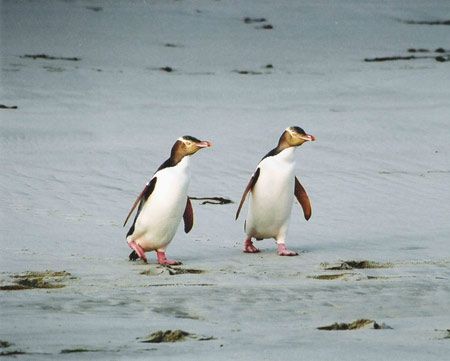
The yellow-eyed penguin is one of the few penguin species found north of the Antarctic Ocean, and as it's name suggests, this species of penguin is easily idenitfied by it's yellow coloured eyes and bright yellow band that runs from it's eyes round the back of the yellow-eyed penguin's head. The yellow-eyed penguin is found off the coast of the south island of New Zealand where this species gathers in colonies along the beaches and boulder fields. The yellow-eyed penguin is also found on a few of the islands of the main island including Stewart, Auckland and the Campbell Islands.


The yellow-eyed penguin generally searches for food up 10 miles offshore, and travels (on average) around 15 miles away from the colonies nesting site. The yellow-eyed penguin leaves the colony at dawn and returns the same evening during chick rearing, although may spend 2 or 3 days at sea at other times. The yellow-eyed penguin is one of the larger species of penguin with adult individuals reaching 75cm in height, with the males generally being slightly larger than the female yellow-eyed penguins.


The yellow-eyed penguin is a carnivorous animal, that like all other penguin species, survives on a diet that is only comprised of marine animals. Krill and small crustaceans make up the bulk of the yellow-eyed penguin's diet along with larger organisms including squid and various species of fish. The yellow-eyed penguin is usually found nesting in the forests and scrub that line the New Zealand coast and although historically undisturbed, the yellow-eyed penguin now has a number of land-dwelling predators including cats, dogs and foxes along with rats and weasels that hunt their eggs.


On average, the yellow-eyed penguin breeds once a year, forming pairs that usually remain faithful to one another. The female yellow-eyed penguin lays two eggs in her nest in the forest which are incubated by both parents for up to a couple of months, when only one of the eggs will usually hatch. The yellow-eyed penguin chicks are fed and kept warm by their parents and remain with them until the chicks are nearly a year old. Today, the yellow-eyed penguin listed as an endangered animal with an estimated wild population of less than 4,000 individuals. Source
Read More

Contact Form

Name

Email *

Message *