Showing posts with label Threatened. Show all posts
// // 4 comments

Monitor Lizard Biography and Facts


Biography of Monitor Lizard

Monitor Lizards are large reptiles found in Africa and all across Asia, including the surrounding seas. This lizard is mainly found in jungle areas although some species of monitor lizard are water-bound. Some species are thought to carry a fairly weak venom, for example, the komodo dragon which is the largest of the species. The komodo dragon is native to the small Indonesian island that it is named after and is the largest species of lizard in the world.


According to legend, monitor lizards were a sign that there were crocodiles close by, possibly due to their standing on their hind legs to monitor their surroundings. Monitor lizards do this so that they are aware of any approaching predators. Although many species are quite big, some species are smaller than 20 cm in length. Monitor lizards are extremely versatile animals and monitor lizards adapt well into different environments.


Facts about Monitor Lizards

Most species of monitor lizard have a predominantly carnivorous diet, eating eggs, smaller reptiles, fish, birds and small mammals. Some species of monitor lizard also eat fruit and vegetation depending on where they live. Female monitor lizards bury their eggs in holes or hollow tree stumps that the female monitor lizard then covers with dirt in order to protect her eggs. These lizards can lay up to 30 eggs at a time, although many lizards lay less, and only a lucky few of the monitor lizard babies tend to survive.


Monitor lizards are thought to be fairly intelligent animals, with some people claiming that are able to recognise numbers up to six, therefore meaning that lizards are able to count! Monitor lizards mainly use their intelligence in the wild by surveying areas for oncoming danger and for hunting their prey.
Read More
// // 1 comment

Mole (Animal)

Life of Moles

Moles are a small mammals that are most well known for living in tunnels underground. Moles are commonly found in Europe, Asia, South Africa and North America although there are oddly no moles inhabiting Ireland. These have long, curved claws which the moles use to burrow underground. They can quickly create long tunnels under the surface of the earth and the tunnel entrances can easily be identified by the mounds of earth that appear (normally all over your garden lawn)! These mounds of soil are commonly known as mole hills.

Different Species of Mole

There are around 20 different species of mole found in their natural, earthy environments. Some species of these animals are also aquatic or at least semi-aquatic which means that these mole species spend at least some of their time in the water. Many of the different species of mole are very similar in appearance and range in size from just 2 cm to 2 cm. The oddest exception to this is the star-nosed mole that inhabits parts of Canada and the northeast of the USA. The star-nosed mole can be easily identified by the distinctive star shaped ending to the star-nosed moles snout.


Moles are omnivores that primarily feed and hunt earthworms. The saliva in the mouth of the mole contains a toxin that can paralyze small animals such as earthworms meaning that the mole is able to eat its catch successfully but the mole is also able to store food to eat later. Moles are known to construct special underground larders in which the mole can store its food. Some of the larger species of mole have also been known to eat small mice. The mole does this by catching the mouse at the entrance to its burrow. The eyes and ears of the mole are very small and usually covered in fur.

Mole Photo Credit www.naturfoto.cz

Moles breed in early spring with the female moles gestation period lasting about a month. The female then gives birth to between 2 and 6 mole babies. The baby are usually completely independent within a month after birth. The average lifespan of a mole is about 4 years but some species have been known to live until they are 6 or 7 years old. Due to their small size, moles are preyed about by mammals, birds and reptiles when the moles are above ground.
Read More
// // 2 comments

Mandrill

Biography of Mandrill

The mandrill is a medium to large sized primate, natively found in a small pocket of tropical jungle in western-central Africa. The mandrill is most commonly known for it's red and blue coloured nose and it's multicoloured rear end. The mandrill is not related to the great apes but is thought to be closely related to the baboon, another medium-sized African primate that is found in eastern and southern Africa. The mandrill was even once thought to be a sub-species of baboon but this is now not believed to be the case.


Mandrill Habitat

The Mandrill is found in the tropical rainforests and occasionally grasslands of southern Cameroon, Gabon, Equatorial Guinea, and Congo in western-central Africa. The mandrill's habitat is bordered by the Sanaga River to the north and the Ogooué and Ivindo rivers to the east. Recent research suggests that mandrill populations north and south of the Ogooué river are so genetically different that they are in fact separate subspecies. Mandrills have distinctively coloured noses and rumps which make them stand out in the forest.


Troops of Mandrill

Mandrills are sociable animals and inhabit areas of forest in large groups known as a troop. The mandrill troop primarily includes female mandrills and their young who are led by a single dominant male mandrill. The alpha male mandrill both mates with his females and protects them. Most adult male mandrills that are not leading a troop tend to be solitary animals. Mandrills are omnivorous animals and therefore eat almost anything. The mandrill primarily feeds on fruits, berries, seeds, nuts, roots, leaves, insects and even small mammals and reptiles. Most of the mandrills diet is found at ground level or just above.


Due to their large size, mandrills have few predators in their natural environment. The leopard is the main predator of the mandrill, along with large snakes and birds of prey, who prey more upon the mandrill young. The human is also one of the mandrill's main predators as they have hunted the mandrill over the years for meat. Today the mandrill is considered to be an animal species that is vulnerable to extinction, as mandrill population numbers have been declining due to over-hunting an habitat loss.
Read More
// // Leave a Comment

Macaroni Penguin


The macaroni penguin is a large-sized species of penguin found in the Sub-Antarctic regions. the macaroni penguin is one of six species of crested penguins is so closely related to the royal penguin, that some people class the two as the same species. The macaroni penguin spends most of its time during the colder winter months fishing in the cold oceans where the macaroni penguin is more protected from the bitter conditions of the Antarctic winter on the land.


The macaroni penguin is the most numerous species of penguin on the planet as there approximately 18 million macaroni penguin individuals. The macaroni penguin population numbers are declined severely over the past few decades meaning that the macaroni penguin is today considered to be a vulnerable species. Macaroni penguins are one the biggest and heaviest species of penguin as adult macaroni penguins generally average about 70cm in height. The macaroni penguin also has a couple of very distinctive features including a long red-coloured beak and a crest of thin bright-yellow feathers on its head.


Like other penguin species, the macaroni penguin is a carnivorous animal as the only source of food is in the surrounding water. The macaroni penguin spends six months during the cold winter months hunting fish, squid, krill and crustaceans which the macaroni penguin catches in its long beak. The macaroni penguin only has a couple of natural predators in the freezing Antarctic Ocean as there are only a number of animal species that can survive there. Leopard seals, killer whales and the occasional passing shark are the only real predators of the macaroni penguin.


The macaroni penguin returns to the land during the warmer summer months in order to breed. Macaroni penguins gather in large colonies which can contain up to 100,000 individuals in order to lay their eggs. Female macaroni penguins generally lay two eggs a couple of days apart that hatch after about six weeks. Both the male and female macaroni penguin parents help to incubate the eggs and raise the chicks. Source
Read More
// // Leave a Comment

Leopard Tortoise


The leopard tortoise is a large species of tortoise found throughout the African savannas. The leopard tortoise is the forth largest species of tortoise in the world, and is also the most widely distributed tortoise species in Southern Africa. The leopard tortoise has a wide distribution in sub-Saharan Africa from Sudan to the Cape. As a grazing species of tortoise, the leopard tortoise is most commonly found in semi-arid areas including shrubland and grasslands.


The leopard tortoise is one of the world's largest tortoise species as they can grow to 70 cm in length and weigh about as much as a small person. As with other tortoise species, the leopard tortoise has a large shell which protects it's softer body. The limbs of the leopard tortoise are able to retract back into the leopard tortoise's shell so that no body part is left vulnerable. The leopard tortoise is a generally solitary animal that spends the majority of it's time grazing on plants, which it can do effectively using it's sharp beak-like mouth. As with other tortoise species, the leopard tortoise is a long-lived animal species, often reaching 100 years old or even more.

Leopard tortoise Credit

The leopard tortoise is a herbivorous animal meaning that it only eats plants and plant material in order to sustain itself. The leopard tortoise primarily grazes on grasses, leaves, berries and flowers along with fruits such as the prickly pear. Due to it's fairly large size, the leopard tortoise has few natural predators within it's African habitats as many simply cannot penetrate the leopard tortoise's high-domed shell. Humans are the primary predators of the leopard tortoise along with the occasional wild cats and dogs.

Leopard tortoise Credit

Leopard tortoises are not able to reproduce until they are at least 10 years old (known as reaching sexual maturity). As with other tortoise and even reptile species, the female leopard tortoise lays her clutch of up to 18 eggs into a burrow in the ground, which is quickly covered to protect her young from hungry passers-by. Although there are thriving populations of leopard tortoises in more remote areas, when they are close to humans, the leopard tortoise populations are generally suffering, something which is primarily due to over-hunting by humans. Source
Read More
// // 5 comments

Komodo Dragon


The komodo dragon also known as the giant monitor lizard, is the largest species of lizard in the world.The komodo dragon inhabits the rainforests of Southeast Asia, and the komodo dragon is native to just a few islands in Indonesia that are part of the Komodo Island National Park. Fossil evidence however, suggests that the komodo dragon once had a much larger habitat but this has been severely decreased due to deforestation. Komodo dragons are completely dominant predators in their environment, and are named by the locals as the land crocodile due to their large size and habit of eating seemingly anything that the komodo dragons can find.


The komodo dragon has an exceptional sense of smell meaning that the komodo dragon is able to hunt out its prey up to 8 km away, when aided by the wind blowing in the right direction. Recent discoveries have revealed that the komodo dragon is indeed venomous, and does not kill its prey through lethal bacteria, as previously thought. However, once the damage the komodo dragon can do coupled with the fact that the saliva of the komodo dragon is known to carry more than 50 different strains of bacteria, means that any animal that manages to survive the attack of a komodo dragon, is extremely likely to die of infection.


The komodo dragon hunts anything that comes into contact with the komodo dragon, including its own eggs! Generally komodo dragons are not known to actively hunt humans, but the komodo dragon is known to be one of the man-eating animals in the world, as it is not uncommon for the komodo dragon to attack and eat humans that get in its way. To hunt their prey, komodo dragons rely heavily on their camouflage in the long grass and great patience as the komodo dragons sit and wait for prospective prey to pass.


Due to the fact that the komodo dragon is an apex predator in its limited environment, the komodo dragon will often live to more than 30 years of age. The main exception to this is the side effects that occur due to deforestation and areas where there is a lack of food for the komodo dragon to hunt. Today there are thought to be around 3,000 komodo dragon individuals left in the wild with less than a third of them being female komodo dragons that are of the age to breed. Source
Read More
// // Leave a Comment

Kiwi


The kiwi is a brown, fuzzy, flightless bird native to the forests and jungles of New Zealand. In recent years the kiwi has become endangered, mainly due to introduced predators like dogs, cats, rats, ferrets and weasels which hunt the kiwi and eat it's eggs. The kiwi is almost helpless against these exotic threats and there are many support organizations for kiwis which run conservation projects to try and protect the remaining kiwi population. The largest of these kiwi conservation projects is run by the Bank of New Zealand.


There are many different species of kiwi, but all of them can only be found inhabiting the forests of New Zealand. It is believed that the incredible diversity of this island nation is due to its early separation from Australia and the rest of the continents, millions of years ago, by way of tectonic plate shifting. The kiwi is the national bird and icon of New Zealand. In fact, the native people of New Zealand are often also called Kiwis. The kiwi also appears on many flags and symbols across the islands.


The eggs of the kiwi weigh about one pound which is 450g. The beak of the kiwi is about the size of one third of the kiwi's body. The kiwi uses it's long beak to rummage through the foliage on the ground in search of food. Kiwis are omnivorous animals and eat a variety of both plants and animals. The kiwi mainly hunts out worms, insects and spiders but also eats fruits and berries, generally those that have fallen to the forest floor.


The kiwi is thought to be related to the ostrich and the emu, making the kiwi the smallest member of this family of birds. Like it's larger cousins, the kiwi is unable to fly due to it's small wing span and large weight. The kiwi therefore spends it's life foraging on the forest floor. Although kiwis are generally solitary animals, kiwis are known to live in pairs for parts of their lives. These kiwi couples mate only with each other and the female kiwi is known to be larger than the male kiwi, meaning the female kiwi is generally the dominant bird. Source
Read More
// // 1 comment

Kingfisher


The kingfisher is a small to medium sized colourful bird generally found close to water.There are nearly 100 different species of the kingfisher bird found around the world. Kingfishers live both in wetlands and woodlands worldwide, feeding mainly on fish but also insects, frogs and crayfish with those kingfisher species that live in the woodlands occasionally eating reptiles, birds and even small mammals.


There are three main types of kingfisher around the globe which are the river kingfishers, the tree kingfishers and the water kingfishers all of which have large heads, long sharp pointed bills, short legs, and stubby tails. The smallest species of kingfisher is the African Dwarf Kingfisher, which gets to an average of 10.4 g in weight and just 10 cm (4 inches) in length. The largest kingfisher species is the Giant Kingfisher, which gets to an average of 355 g (13.5 oz) and grows to 45 cm (18 inches).


Kingfishers nest in tree hollows and holes dug into the ground, which tend to be in river banks or at the sides of lakes. Kingfishers dig small tunnels with their nest at the end, which can range in length depending on the species. The giant kingfisher is known to dig tunnels that are over 8 meters long! Female kingfishers lay up to 10 eggs (although normally less), and both the male and the female kingfishers help to incubate the eggs, which hatch in between 3 and 4 weeks. Kingfishers are well known for their brightly coloured feathers which range in colour from black to red to green.


Due to their generally small size, kingfishers have a number of predators wherever they exist around the world. The main predators of the kingfisher are foxes, raccoons, cats and snakes, but kingfishers are also preyed upon by other small mammals and large birds. The eggs of the kingfisher are also preyed upon by many of the kingfisher's predators. Many species of kingfisher are considered to be threatened species as their numbers have been declining mainly due to habitat loss. These threatened species of kingfisher tend to be the kingfisher species that inhabit woodland and forests as their habitat is being destroyed due to deforestation which occurs in many areas around the world. Source
Read More
// // Leave a Comment

King Crab


King crabs also called stone crabs, are a superfamily of crab-like decapod crustaceans chiefly found in cold seas. Because of their large size and the taste of their meat, many species are widely caught and sold as food, the most common being the red king crab, Paralithodes camtschaticus. King crabs are generally thought to be derived from hermit crab-like ancestors, which may explain the asymmetry still found in the adult forms.


Although some doubt still exists about this theory, king crabs are the most widely quoted example of carcinisation among the Decapoda. The evidence for this explanation comes from the asymmetry of the king crab's abdomen, which is thought to reflect the asymmetry of hermit crabs which is located in the west cost, which must fit into a spiral shell. Although formerly classified among the hermit crabs in the superfamily Paguroidea, king crabs are now placed in a separate superfamily, Lithodoidea.


King Crabs are known for their sheer size but only a couple of species get really big. King crabs are mainly found in the Southern Hemisphere where the waters are warmer but the Alaskan king crab is the obvious exception to this as the waters there are near freezing. Red king crabs can have a leg span of up to 1.8m, blue king crabs often weigh over 8kg! King crabs hunt small fish and plankton in the oceans and are often found close to coral reefs or rocky areas where there are plenty of places for the king crab to hide.


The king crab is generally believed to come from the ancestors of hermit crabs, as with many species of crab today. King crabs are hunted all year round by fisherman and the king crab is seen to be delicacy in many parts of the world. There are thought to be around 40 different species of king crab today, nearly all of which are hunted for food by humans due to their large size and the taste of their flesh. The most popular king crab for a human catch, is the red king crab as the red king crab is one of the largest species and one of the most readily available species of king crab in the ocean. Source
Read More
// // Leave a Comment

Koala


The koala is a small bear-like mammal native to the forests of Australia. The koala does not exist in western Australia but can instead be commonly found on the east coast of Australia. Despite the bear-like appearance of the koala, the koala is not a species of bear but is a marsupial as the koala has a pouch on its tummy in which the baby koalas are carried in. The koala is a seemingly fairly docile creature, with the koala spending its time sleeping in the tops of eucalyptus trees. The koala eats the leaves of the eucalyptus tree which accounts for the majority of the diet of the koala.

Koala Credit

The koala in southern Australia was very nearly wiped out by Victorian settlers in the 1800s. Koala conservation work is underway, as the koala numbers slowly repopulate the southern population of the koala. There are believed to be three different subspecies of the koala, although these koala subspecies differ very little from one another. The main noted difference between koala subspecies is the today less common southern koala tends to be slightly larger than the other koalas further north.
 

Female koalas are able to start giving birth to baby koalas when the female koala is between two and three years old. Healthy female koalas will then tend to have one baby koala every year for more than 10 years. Baby koalas are weaned from birth by the mother koala on both the milk of the mother koala and eucalyptus leaves and until the baby koala is about 12 months old. Female baby koalas will tend to leave their mother at this stage and will move to surrounding forest in order to begin starting their own family.
 

Male baby koalas will generally stay with their mother until they are around 2 or 3 years old, and the male will then leave the home of the mother koala in order to find a mate. When a baby koala is first born, the baby koala spends the first 6 months of its life hidden in the pouch on the front of the mother koala. During this time, the baby koala will eat nothing but the milk produced by the mother koala and the baby koala will also grow its fur, ears and eyes. The baby koala will then be ready to begin exploring the world outside the warm pouch of the mother koala. Source
Read More
// // Leave a Comment

Jaguar


The jaguar is the largest feline on the American continent, with jaguars also being the third biggest cat in the world behind the African lion and the Asian tiger. Jaguars have the strongest bite force of all the cats and like other pantherines they can roar. The jaguar is indigenous to the Western Hemisphere. Jaguars inhabit the tropical rainforest's of South America with the elusive jaguar spending a great deal of its time asleep in the trees or hunting in dense undergrowth. However, due to the habitat loss within this jaguar kingdom, the jaguar population numbers are declining making jaguars an endangered species.


Jaguars have a similar rosetting pattern to a leopard, but the jaguar has a much heavier and sturdier build. Jaguars hold the reputation for being very aggressive, though attacks on humans have historically been rare. Undoubtedly a strikingly beautiful animal, the jaguar has caught the attention of scientists and hunters alike, with many jaguar individuals having been poached for their distinctively patterned fur. Black jaguars occur from time to time. In jaguars the black colouration is a simple dominant gene. Two black jaguars can produce a lighter spotted cub in a litter of blacks. As with black leopards, you can see the spotting as black on black in strong sunlight.


Jaguars tend to prefer thick, dense, moist jungle where the jaguar has plenty of cover in order to successfully hunt and the ambush prey. Although this is the case, jaguars appear to be fairly adaptable animals and jaguars have been known to reside in reed thickets, shrub land and swamps. A jaguar was found in the desert region of southern Arizona a couple of years ago. The highest concentration of jaguars is today found around the Amazon Basin, where there is plenty of food, water and shelter for the jaguar to live undisturbed.


Although jaguar cubs are generally born between the months of December and March, it is not uncommon for jaguar cubs to be born throughout the year. Female jaguars typically give birth to two or three jaguar cubs. In mating season, the female jaguar will use loud vocal calls to attract a male jaguar into her territory. Once the jaguar cubs are born however, the female jaguar will not tolerate the male jaguar in her territory as the female jaguar becomes very protective of her cubs at this stage. Jaguar cubs are born blind and gain their sight after about two weeks. Source
Read More
// // Leave a Comment

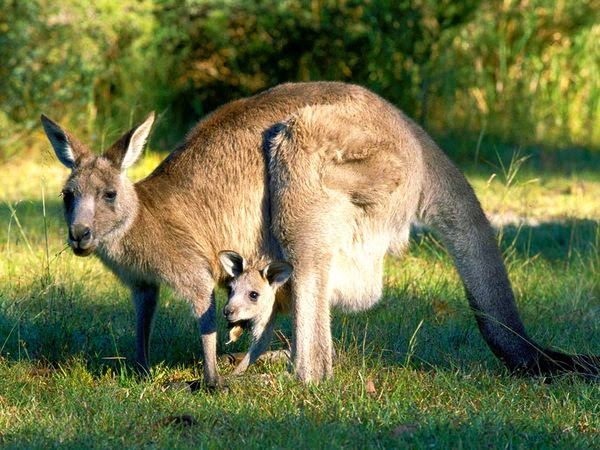
Kangaroo

Kangaroo Credit

The kangaroo is a marsupial that is indigenous to Australia and and the Indonesian island of New Guinea. Although kangaroos are often seen congregating in groups, kangaroos are generally fairly solitary mammals but kangaroos are also known for being sociable animals when with other kangaroos. Kangaroos have a deep pouch on their front in which to carry their young. A baby kangaroo is called a joey. Kangaroos eat plants, nuts, berries and insects that the kangaroos rummage for in the arid wilderness.


Kangaroos are most well known for their ability to jump a phenomenal distance. The kangaroo is the largest of the marsupials, a group an animals that includes koalas and the common brushtail possum. Marsupials are distinguished by the pouch that these animals have on their bellies, in which they carry their young. There are three main species of kangaroo in existence today and these are the red kangaroo, which is the largest and most well-known of all the kangaroo species.
 
 Kangaroo Credit
 
The Eastern grey kangaroo is known to be the heaviest species of kangaroo despite the fact that the red kangaroo is taller. The western grey kangaroo can be found in large numbers and can be anywhere in colour from grey to brown. The kangaroo is the national animal and emblem of Australia. Kangaroos have large, flat feet which the kangaroos use in order to aid their movement which the kangaroos do by hopping.


Despite the fact that kangaroos do not move about in the conventional way, kangaroos can often be seen running at high speeds, generally when the kangaroo is scared or being chased by oncoming predators. Although kangaroos are not commercially farmed, wild kangaroos are often pursued by human hunters for sport, meat, fur and when farmers are conserving their grazing land for their sheep and cows. This method of sustainable hunting is said to have more health and environmental benefits than that of sheep and cattle. Source
Read More
// // 1 comment

Hyena


The hyena is a carnivorous dog-like species of animal, native to parts of both Africa and Asia. There are four known species of hyena, the spotted hyena, the striped hyena, the brown hyena and the aardwolf. Hyenas are scavenger mammals meaning that the hyena tends to eat another animals kill, rather than the hyena actually catching its own food. The hyena is well known for its cackling laugh-like scream, which the hyena is believed to use in order to alert other hyenas of a source of food. This hyena call is thought to be able to be heard by other hyenas for up to three miles.


The hyena is a remarkably intelligent animal. Hyenas are thought to have being compared to primates and humans in the evolutionary status of the hyenas brain. All four hyena species have a bear-like stance as the front legs of a hyena are longer than the back legs of a hyena. The striped hyena, the brown hyena and the aardwolf all have a striped mane on the top of the hyenas neck that stands up when the hyena is frightened. The main of a spotted hyena is considerably shorter and appears to stand on end the majority of the time.


Despite the hyenas once large range across Africa and parts of Asia and Europe, all four hyena species are today found mostly in the African Savannah. The only exception to this is that the striped hyena is often seen roaming in the jungles of India, and western Asia. The hyena is said to be one of the most abundant large carnivores on the African continent and the hyena is often viewed as an irritant by other large carnivores who actually make a kill that is then stolen by a hyena pack.


The only animal that will hunt and kill a hyena intentionally is a human being. Humans and hyenas have a long history of conflict ranging from hyenas killing livestock for an easy meal and the fact that humans used to believe that hyenas were related to witchcraft and supernatural activity, naturally making the human very wary of the hyena. Hyenas group together in packs with the den of the hyena pack generally being in the center of their territory. Source
Read More

Contact Form

Name

Email *

Message *