Showing posts with label Omnivore. Show all posts
// // 4 comments

Monitor Lizard Biography and Facts


Biography of Monitor Lizard

Monitor Lizards are large reptiles found in Africa and all across Asia, including the surrounding seas. This lizard is mainly found in jungle areas although some species of monitor lizard are water-bound. Some species are thought to carry a fairly weak venom, for example, the komodo dragon which is the largest of the species. The komodo dragon is native to the small Indonesian island that it is named after and is the largest species of lizard in the world.


According to legend, monitor lizards were a sign that there were crocodiles close by, possibly due to their standing on their hind legs to monitor their surroundings. Monitor lizards do this so that they are aware of any approaching predators. Although many species are quite big, some species are smaller than 20 cm in length. Monitor lizards are extremely versatile animals and monitor lizards adapt well into different environments.


Facts about Monitor Lizards

Most species of monitor lizard have a predominantly carnivorous diet, eating eggs, smaller reptiles, fish, birds and small mammals. Some species of monitor lizard also eat fruit and vegetation depending on where they live. Female monitor lizards bury their eggs in holes or hollow tree stumps that the female monitor lizard then covers with dirt in order to protect her eggs. These lizards can lay up to 30 eggs at a time, although many lizards lay less, and only a lucky few of the monitor lizard babies tend to survive.


Monitor lizards are thought to be fairly intelligent animals, with some people claiming that are able to recognise numbers up to six, therefore meaning that lizards are able to count! Monitor lizards mainly use their intelligence in the wild by surveying areas for oncoming danger and for hunting their prey.
Read More
// // 1 comment

Mole (Animal)

Life of Moles

Moles are a small mammals that are most well known for living in tunnels underground. Moles are commonly found in Europe, Asia, South Africa and North America although there are oddly no moles inhabiting Ireland. These have long, curved claws which the moles use to burrow underground. They can quickly create long tunnels under the surface of the earth and the tunnel entrances can easily be identified by the mounds of earth that appear (normally all over your garden lawn)! These mounds of soil are commonly known as mole hills.

Different Species of Mole

There are around 20 different species of mole found in their natural, earthy environments. Some species of these animals are also aquatic or at least semi-aquatic which means that these mole species spend at least some of their time in the water. Many of the different species of mole are very similar in appearance and range in size from just 2 cm to 2 cm. The oddest exception to this is the star-nosed mole that inhabits parts of Canada and the northeast of the USA. The star-nosed mole can be easily identified by the distinctive star shaped ending to the star-nosed moles snout.


Moles are omnivores that primarily feed and hunt earthworms. The saliva in the mouth of the mole contains a toxin that can paralyze small animals such as earthworms meaning that the mole is able to eat its catch successfully but the mole is also able to store food to eat later. Moles are known to construct special underground larders in which the mole can store its food. Some of the larger species of mole have also been known to eat small mice. The mole does this by catching the mouse at the entrance to its burrow. The eyes and ears of the mole are very small and usually covered in fur.

Mole Photo Credit www.naturfoto.cz

Moles breed in early spring with the female moles gestation period lasting about a month. The female then gives birth to between 2 and 6 mole babies. The baby are usually completely independent within a month after birth. The average lifespan of a mole is about 4 years but some species have been known to live until they are 6 or 7 years old. Due to their small size, moles are preyed about by mammals, birds and reptiles when the moles are above ground.
Read More
// // 2 comments

Mandrill

Biography of Mandrill

The mandrill is a medium to large sized primate, natively found in a small pocket of tropical jungle in western-central Africa. The mandrill is most commonly known for it's red and blue coloured nose and it's multicoloured rear end. The mandrill is not related to the great apes but is thought to be closely related to the baboon, another medium-sized African primate that is found in eastern and southern Africa. The mandrill was even once thought to be a sub-species of baboon but this is now not believed to be the case.


Mandrill Habitat

The Mandrill is found in the tropical rainforests and occasionally grasslands of southern Cameroon, Gabon, Equatorial Guinea, and Congo in western-central Africa. The mandrill's habitat is bordered by the Sanaga River to the north and the Ogooué and Ivindo rivers to the east. Recent research suggests that mandrill populations north and south of the Ogooué river are so genetically different that they are in fact separate subspecies. Mandrills have distinctively coloured noses and rumps which make them stand out in the forest.


Troops of Mandrill

Mandrills are sociable animals and inhabit areas of forest in large groups known as a troop. The mandrill troop primarily includes female mandrills and their young who are led by a single dominant male mandrill. The alpha male mandrill both mates with his females and protects them. Most adult male mandrills that are not leading a troop tend to be solitary animals. Mandrills are omnivorous animals and therefore eat almost anything. The mandrill primarily feeds on fruits, berries, seeds, nuts, roots, leaves, insects and even small mammals and reptiles. Most of the mandrills diet is found at ground level or just above.


Due to their large size, mandrills have few predators in their natural environment. The leopard is the main predator of the mandrill, along with large snakes and birds of prey, who prey more upon the mandrill young. The human is also one of the mandrill's main predators as they have hunted the mandrill over the years for meat. Today the mandrill is considered to be an animal species that is vulnerable to extinction, as mandrill population numbers have been declining due to over-hunting an habitat loss.
Read More
// // 2 comments

Macaw

Scarlet Macaw Credit

The macaw is a colourful tropical parrot native to Central and Southern America. There are 17 different species of macaw found in the rainforests of South America. Many of the different macaw species are today considered to be endangered animals. The macaw is an omnivorous animal and feeds on nuts and fruit in the trees along with insects, eggs and small mammals and reptiles. The macaw is known to sleep during the night meaning that the macaw is a diurnal animal, and in the morning the macaw will often fly long distances in order to find food.

Blue Macaw Credit

The macaw is one of the largest species of parrot in the world, with the average adult macaw growing to more than a meter in height. The macaw is well known for it's array of brightly coloured feathers which are often many different colours including blue, red, yellow and green. Macaws have recently become very popular as pets, and there is a flourishing black market for some of the rarer breeds of macaw. This only contributes to their endangered status. Please, do not buy imported macaws.


The macaw has a large and powerful beak which means that the macaw can break the shells of nuts and seeds more easily. Like other species of parrot, macaws have four toes on each foot, with two toes facing forward and two toes facing backward. This foot adaptation helps the macaw to grip onto prey and tree branches more easily and allows the macaw to perch in the trees without slipping off. Macaws are known to be intelligent and very sociable birds and macaws can often be seen together in large flocks of up to 30 macaw individuals.


The macaw is one of the world's animals that is known to have the same breeding partner for their whole lives. Macaw couples do not only breed together but they also share their food and help to groom one another. When the female macaw has laid her eggs (typically 2 but more are common), the female macaw sits on her eggs to incubate them while the male macaw hunts and collects food for them both. The macaw chicks hatch after about a month. Source
Read More
// // Leave a Comment

Kiwi


The kiwi is a brown, fuzzy, flightless bird native to the forests and jungles of New Zealand. In recent years the kiwi has become endangered, mainly due to introduced predators like dogs, cats, rats, ferrets and weasels which hunt the kiwi and eat it's eggs. The kiwi is almost helpless against these exotic threats and there are many support organizations for kiwis which run conservation projects to try and protect the remaining kiwi population. The largest of these kiwi conservation projects is run by the Bank of New Zealand.


There are many different species of kiwi, but all of them can only be found inhabiting the forests of New Zealand. It is believed that the incredible diversity of this island nation is due to its early separation from Australia and the rest of the continents, millions of years ago, by way of tectonic plate shifting. The kiwi is the national bird and icon of New Zealand. In fact, the native people of New Zealand are often also called Kiwis. The kiwi also appears on many flags and symbols across the islands.


The eggs of the kiwi weigh about one pound which is 450g. The beak of the kiwi is about the size of one third of the kiwi's body. The kiwi uses it's long beak to rummage through the foliage on the ground in search of food. Kiwis are omnivorous animals and eat a variety of both plants and animals. The kiwi mainly hunts out worms, insects and spiders but also eats fruits and berries, generally those that have fallen to the forest floor.


The kiwi is thought to be related to the ostrich and the emu, making the kiwi the smallest member of this family of birds. Like it's larger cousins, the kiwi is unable to fly due to it's small wing span and large weight. The kiwi therefore spends it's life foraging on the forest floor. Although kiwis are generally solitary animals, kiwis are known to live in pairs for parts of their lives. These kiwi couples mate only with each other and the female kiwi is known to be larger than the male kiwi, meaning the female kiwi is generally the dominant bird. Source
Read More
// // 1 comment

Kingfisher


The kingfisher is a small to medium sized colourful bird generally found close to water.There are nearly 100 different species of the kingfisher bird found around the world. Kingfishers live both in wetlands and woodlands worldwide, feeding mainly on fish but also insects, frogs and crayfish with those kingfisher species that live in the woodlands occasionally eating reptiles, birds and even small mammals.


There are three main types of kingfisher around the globe which are the river kingfishers, the tree kingfishers and the water kingfishers all of which have large heads, long sharp pointed bills, short legs, and stubby tails. The smallest species of kingfisher is the African Dwarf Kingfisher, which gets to an average of 10.4 g in weight and just 10 cm (4 inches) in length. The largest kingfisher species is the Giant Kingfisher, which gets to an average of 355 g (13.5 oz) and grows to 45 cm (18 inches).


Kingfishers nest in tree hollows and holes dug into the ground, which tend to be in river banks or at the sides of lakes. Kingfishers dig small tunnels with their nest at the end, which can range in length depending on the species. The giant kingfisher is known to dig tunnels that are over 8 meters long! Female kingfishers lay up to 10 eggs (although normally less), and both the male and the female kingfishers help to incubate the eggs, which hatch in between 3 and 4 weeks. Kingfishers are well known for their brightly coloured feathers which range in colour from black to red to green.


Due to their generally small size, kingfishers have a number of predators wherever they exist around the world. The main predators of the kingfisher are foxes, raccoons, cats and snakes, but kingfishers are also preyed upon by other small mammals and large birds. The eggs of the kingfisher are also preyed upon by many of the kingfisher's predators. Many species of kingfisher are considered to be threatened species as their numbers have been declining mainly due to habitat loss. These threatened species of kingfisher tend to be the kingfisher species that inhabit woodland and forests as their habitat is being destroyed due to deforestation which occurs in many areas around the world. Source
Read More
// // Leave a Comment

Howler Monkey


Howler monkeys (genus Alouatta monotypic in subfamily Alouattinae) are among the largest of the New World monkeys. Fifteen species are currently recognised. Previously classified in the family Cebidae, they are now placed in the family Atelidae. These monkeys are native to South and Central American forests. Threats to howler monkeys include human predation, habitat destruction and being captured for captivity as pets or zoo animals.


These monkeys are famous for their loud howls, which can travel three miles through dense forest. Howler monkeys have short snouts and wide-set, round nostrils. Their noses are very keen, and the Howler monkey can smell out its food (primarily fruit and nuts) up to 2km away. Their noses are usually roundish snout-type, and the nostrils have many sensory hairs growing from the interior.


They range in size from 56 to 92 cm (22 to 36 in), excluding their tails, which can be equally as long, in fact in some cases the tail has been found to be almost 5 times the body length. This is a prime characteristic. Like many New World monkeys, they have prehensile tails, which they use for picking fruit and nuts from trees. Unlike other New World monkeys, both male and female howler monkeys have trichromatic color vision.

Howler monkey Credit

This has evolved independently from other New World monkeys due to gene duplication. They have lifespans of 15 to 20 years. Howler species are dimorphic and can also be dichromatic (i.e. Alouatta caraya). Males are, on average, 1.5 to 2.0 kg heavier than females. The hyoid of Alouatta is pneumatized, one of the few cases of postcranial pneumaticity outside Saurischia. Howler monkeys generally move quadrupedally on the tops of branches, usually grasping a branch with at least two hands or one hand and the tail at all times.
Read More
// // Leave a Comment

Horseshoe Crab


The horseshoe crab is a hard-shelled invertebrate found on the sea floor in warmer climates. Despite it's name, the horseshoe crab is not actually a crab (or crustacean) and is in fact more closely related to arachnids such as spiders and scorpions. There are four different species of horseshoe crab found inhabiting the warmer shallows off the coasts of India, Japan, Indonesia, the eastern USA, and the Gulf of Mexico.


The horseshoe crab has a hard outer shell, five pairs of legs and a long, thin tail which the horseshoe crab uses for changing direction whilst swimming rather than as a defensive weapon. The appearance of the horseshoe crab is thought to have changed very little from when it first evolved around 500 million years ago. Horseshoe crabs breathe using book gills, which are thin plates found on the abdomen of the horseshoe crab.


Horseshoe crabs are generally nocturnal animals, coming out of the shadows in the darkness in order to hunt for food. As carnivorous animals, horseshoe crabs only eat meat including sea worms, small molluscs and crustaceans. Thanks to their armoured casing, horseshoe crabs have few natural predators and are primarily hunted by sharks and sea turtles. Humans also widely hunt the horseshoe crab around the world, along with coastal birds that pick the horseshoe crabs out of the shallows.


Female horseshoe crabs are known to lay between 60,000 to 120,000 eggs at a time. After mating, the female horseshoe crab lays her eggs into a hole in the sand which she then covers up to protect them. Today, the horseshoe crab is still found widely along the world's warmer coastlines although horseshoe crab populations in certain areas are suffering from high levels of water pollution and over-fishing. Source
Read More
// // Leave a Comment

Kangaroo

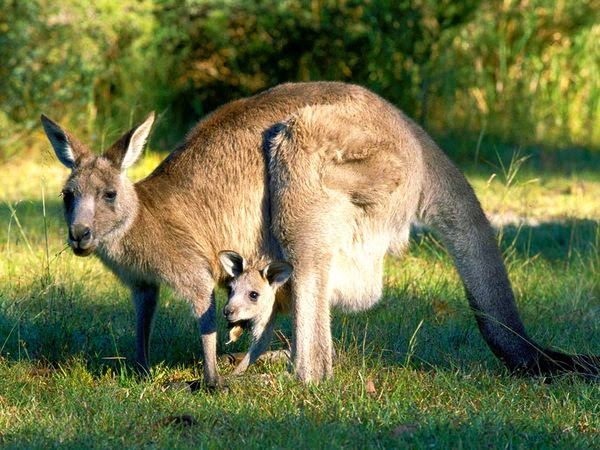
Kangaroo Credit

The kangaroo is a marsupial that is indigenous to Australia and and the Indonesian island of New Guinea. Although kangaroos are often seen congregating in groups, kangaroos are generally fairly solitary mammals but kangaroos are also known for being sociable animals when with other kangaroos. Kangaroos have a deep pouch on their front in which to carry their young. A baby kangaroo is called a joey. Kangaroos eat plants, nuts, berries and insects that the kangaroos rummage for in the arid wilderness.


Kangaroos are most well known for their ability to jump a phenomenal distance. The kangaroo is the largest of the marsupials, a group an animals that includes koalas and the common brushtail possum. Marsupials are distinguished by the pouch that these animals have on their bellies, in which they carry their young. There are three main species of kangaroo in existence today and these are the red kangaroo, which is the largest and most well-known of all the kangaroo species.
 
 Kangaroo Credit
 
The Eastern grey kangaroo is known to be the heaviest species of kangaroo despite the fact that the red kangaroo is taller. The western grey kangaroo can be found in large numbers and can be anywhere in colour from grey to brown. The kangaroo is the national animal and emblem of Australia. Kangaroos have large, flat feet which the kangaroos use in order to aid their movement which the kangaroos do by hopping.


Despite the fact that kangaroos do not move about in the conventional way, kangaroos can often be seen running at high speeds, generally when the kangaroo is scared or being chased by oncoming predators. Although kangaroos are not commercially farmed, wild kangaroos are often pursued by human hunters for sport, meat, fur and when farmers are conserving their grazing land for their sheep and cows. This method of sustainable hunting is said to have more health and environmental benefits than that of sheep and cattle. Source
Read More
// // Leave a Comment

Woodpecker


There are around 200 species of woodpecker inhabiting the forests and woodlands worldwide. Woodpeckers are found on every continent with the exception of the polar regions, Australia and Madagascar. The smallest species of woodpecker is the Bar-breasted Piculet that only grows to 8cm in height. The Gray Slaty woodpecker from south east Asia is the largest living woodpecker in the world with some of these woodpecker individuals growing to nearly 60 cm tall.


The woodpecker has a distinctive long beak, which the woodpecker uses to make holes in trees. The woodpecker does this in order to dig out the grubs living under the bark. The average woodpecker is able to peck up to 20 pecks per second! The woodpecker is only able to peck so much and move it's head so quickly without getting a headache due to the air pockets that help to cushion the woodpecker's brain. Woodpeckers are omnivorous birds and feed on a mixture of plants and animals (mainly insects). The woodpecker eats seeds, berries, fruits, nuts and bugs but the exact species of the woodpecker's food depends upon the area which the woodpecker inhabits.


Most species of woodpecker inhabit forest and woodland areas although oddly enough, there are a few species of woodpecker that live in areas such as deserts and on hillsides, where there are no trees at all. These few woodpecker species still behave in a similar way and nest in holes in rocks and in plants such as cacti. Many of the 200 species of woodpecker on Earth, are today considered to be threatened or endangered animals. This is mainly due to the deforestation that is occurring on mass across the world, meaning that woodpeckers are losing their homes.


Woodpeckers often have quite brightly coloured feathers although the exact colours of the woodpecker's feather depend on the woodpecker species. The brightly coloured feathers of the woodpecker which are often greens, browns, whites, reds and greys, help the woodpecker to camouflage more effectively into the surrounding forest. Woodpeckers make their nests in trees and excavate the hole themselves. Woodpeckers do not usually line the nest as the wood chippings that are there from when the woodpecker made the hole, act as a soft lining. The female woodpecker lays between 3 and 5 eggs that hatch after an incubation period of just a couple of weeks.  Source
Read More
// // Leave a Comment

White Face Capuchin


The white faced capuchin also known as the white headed capuchin and the white throated capuchin, is a medium sized species of monkey that is native to the jungles of Central America and the northern regions of South America. The white faced capuchin is one of the most well known monkeys, particularly in North America, and the white faced capuchin is thought to be one of the most intelligent monkeys in the world with the white faced capuchin being best known as a companion for organ grinders and are also used to assist people that are paraplegic.


The white faced capuchin plays a vital role in the eco-system where the white faced capuchin inhabits, as the white faced capuchin is one of the most effective dispersers of plant and fruit seeds throughout the jungle. The white faced capuchin does this by eating the fruits and berries that grow in the surrounding jungle and the seeds are then put back into the ground in the feces of the white faced capuchin. The white faced capuchin live in troops which generally contain around 20 individual white faced capuchin members.

The white faced capuchin is a highly adaptable mammal and is known to live in all different types of forest in Central and South America. Although the white faced capuchin mainly feeds on fruits and berries, the white faced capuchin also eats insects, plants and even small creatures such as frogs and birds. Within a white faced capuchin troop, there tend to be more female white faced capuchin members than males and as with many other species of sociable primates.


The white faced capuchin troop generally has an alpha male member whose primary role is to breed with the female members and to protect their troop. White faced capuchin troops are not thought to be highly territorial as they spend a great deal of their time on the move. On average a white faced capuchin will travel 2 km every day but there always seems to be conflict when faced with a different troop of white faced capuchin monkeys. Source
Read More
// // Leave a Comment

Western Gorilla


The western gorilla is one of two gorilla sub-groups found on the African continent (the other being the eastern gorilla). The western gorilla is the most numerous species gorilla and also the larger out of the two. The western gorilla is found inhabiting the tropical jungles and forests of western and central Africa, along with lowland swamps and secondary forests. All western gorillas are now considered to be critically endangered as much of their natural habitat has now been deforested or taken over by humans.


There are two separate sub-species of western gorilla which are the western lowland gorilla and the cross river gorilla. Although only slightly different in appearance, the two western gorilla species are distinguished by there differing skull and tooth sizes. The western gorilla is one of the great apes, a group that includes orang-utans, gorillas, humans and chimpanzees. As with the other great apes, the western gorilla has a number of features which makes living in the jungle a bit easier, including having opposable thumbs which come in handy when the western gorilla is peeling fruit.


The western gorilla is an omnivorous animal, but the majority of it's diet is made up of eating fruit which the western gorilla is known to travel vast distances through the forests to find. The western gorilla also eats leaves, nuts and berries, along with insects and occasionally small animals such as lizards and rodents. The western gorilla has also been observed using basic tools in the wild in order to more effectively gather food. Due to it's large size, the western gorilla has few real predators in it's native African forests, with large cats such as leopards and the odd crocodile being the only real natural threat to the western gorilla.


The western gorilla tends to live in groups which are led and protected by the alpha male. The alpha male western gorilla also mates with the females in his group, producing generally single offspring, known as babies. The western gorilla babies remain with their mother until they are a few years old and become independent. Today, all western gorillas are critically endangered species but there are thought to be 95,000 western lowland gorillas remaining in the wild, significantly more than their cross river gorilla cousins, whose numbers in the wild are thought to to as low as 300 individuals. Source
Read More
// // Leave a Comment

Water Dragon


The water dragon is a large species of lizard native to the forests and jungles of Asia and Australia. Water dragons are arboreal animals meaning that they spend most of their time in the trees, often close to a large body of water. There are two different species of water dragon, which are the Australian water dragon and the Asian water dragon. The Australian water dragon is the smaller of the two water dragon species and is found on the east coast of Australia. Australian water dragons have powerful legs and sharp claws which help them to climb trees more effectively.


The Asian water dragon is the larger and more colourful of the two water dragon species and is found in forests and jungles throughout India, China, Laos, Vietnam, Burma and Thailand. The Asian water dragon also has a third eye (known as the pineal gland), which is thought to be able to detect difference in light. Although water dragons are generally tree-dwelling animals, they also spend a great deal of time in or very close to the water.


Like many other lizard species, water dragons are omnivorous animals eating a variety of plant and animal species. Water dragons primarily prey upon small animals such as lizards, frogs and rodents, insects and fish which they catch will there long tongue. Due to their relatively large size, water dragons have limited predators within their natural environment, although this is entirely dependent on where the area which the water dragon inhabits. Snakes, large birds and carnivorous mammals are the primary predators of the water dragon.


Water dragons hibernate during the cooler winters and begin breeding when they emerge in the spring. The female water dragon digs a burrow in the ground where she lays up to 18 eggs, and then buries them. The water dragon young hatch within a few months and remain close to the nest until they become bigger and more adventurous. Source
Read More

Contact Form

Name

Email *

Message *